


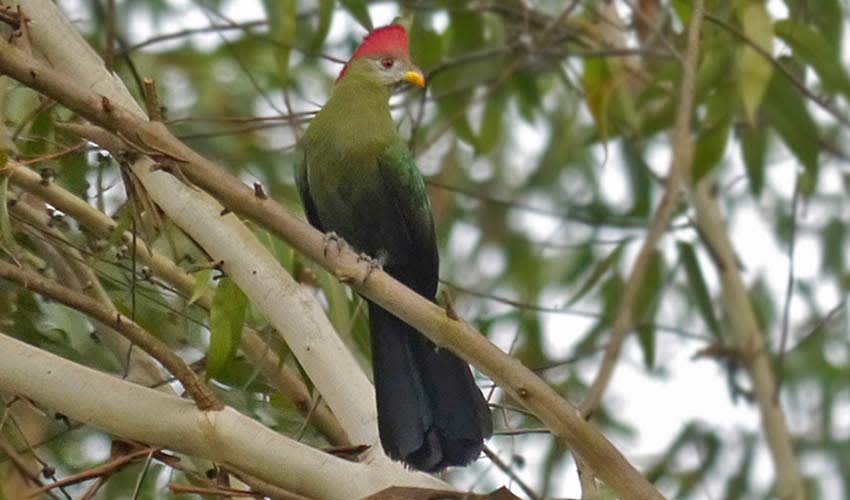
A striking forest bird that feels like a secret hidden in the highlands of Cameroon and Nigeria. Unlike many birds that blend into leaves and shadows, this turaco seems to wear the forest’s brightest colors on purpose. Its body is mainly green, but it has a bold crest and rich accents that make it look both elegant and slightly mischievous, as if it’s always one leap away from a surprise appearance. Turacos are famous for looking almost tropical and “painted,” and Bannerman’s turaco fits that reputation while still keeping a calm, watchful personality.
One thing that makes Bannerman’s turaco stand out is the specialization of its habitat. It prefers cool, misty montane forests—high-elevation forests that can be patchy and limited, like islands of green on mountain slopes. Because these forests are discontinuous, different groups of birds can become separated from each other, making the species more vulnerable when forests shrink or become fragmented. Bannerman’s turaco is also a bird of routine: it often travels the same routes through fruiting trees, using the canopy like a network of roads. You may hear it before you see it, because turacos can be loud, giving sharp calls that echo through the forest and help them keep in contact with family members or warn rivals to stay away.
Like other turacos, Bannerman’s turaco is mostly a fruit-eater, which makes it an important part of its ecosystem. When it feeds on fruit, it also helps spread seeds to new places, supporting the growth of forest plants. It may also eat flowers, buds, and the occasional insect, but fruit is the main event. Because fruit can be seasonal, the bird often shifts where it spends time depending on what trees are producing. Its long tail and strong feet help it balance and hop along branches, and it can spring from limb to limb with impressive control.
Distribution
 Cameroon
 Official estimate
Anything we've missed?
Help us improve this page by suggesting edits. Glory never dies!
Suggest an editGet to know me
Terrestrial / Aquatic
Altricial / Precocial
Polygamous / Monogamous
Dimorphic (size) / Monomorphic
Active: Diurnal / Nocturnal
Social behavior: Solitary / Pack / Herd
Diet: Carnivore / Frugivore / Omnivore / Piscivorous / Insectivore
Migratory: Yes / No
Domesticated: Yes / No
Dangerous: Yes / No




