


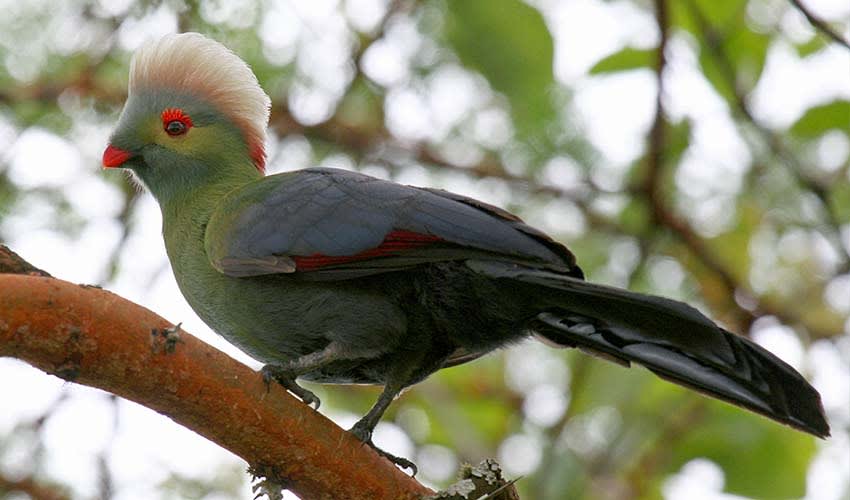
Found in southern Ethiopia, it lives in woodlands and forest edges where green canopies meet drier, more open country. Unlike rainforest birds that depend on thick, wet jungle, Ruspoli’s turaco is adapted to a landscape that can be seasonal and patchy, where food and cover change with the seasons. It still has the classic turaco look—sleek body, long tail, and a neat crest that gives it a slightly “styled” silhouette—but it also carries a tougher, more practical vibe suited to its environment.
One of the most distinctive things about Ruspoli’s turaco is how it moves. It’s not a bird that spends hours gliding across the sky. Instead, it travels through the treetops by hopping, climbing, and leaping from branch to branch, using strong feet to grip and balance. When it flies, it usually does so in quick, direct bursts—more like a short dash between trees than a long flight over open land. This way of traveling makes sense in woodland, where the safest route is often through cover. Its long tail works like a balance pole, helping it make sudden turns and land accurately, almost like an acrobat in a green maze of branches.
Ruspoli’s turaco is best known for its diet and the role it plays in the ecosystem. Like many turacos, it is mainly a fruit-eater, and it will also take buds, flowers, and sometimes insects. Because it moves between fruiting trees, it helps spread seeds from place to place. In habitats that can be broken into smaller patches, this seed dispersal matters a lot because it supports regrowth and keeps plant communities connected. The bird’s daily routine often follows the “fruit calendar” of the woodland: when certain trees are producing, it visits them regularly, and when the season shifts, it shifts too. In a way, it treats the treetops like a network of changing restaurants, always checking what’s in season.
Distribution
 Ethiopia
 Official estimate
Anything we've missed?
Help us improve this page by suggesting edits. Glory never dies!
Suggest an editGet to know me
Terrestrial / Aquatic
Altricial / Precocial
Polygamous / Monogamous
Dimorphic (size) / Monomorphic
Active: Diurnal / Nocturnal
Social behavior: Solitary / Pack / Herd
Diet: Carnivore / Frugivore / Omnivore / Piscivorous / Insectivore
Migratory: Yes / No
Domesticated: Yes / No
Dangerous: Yes / No




