


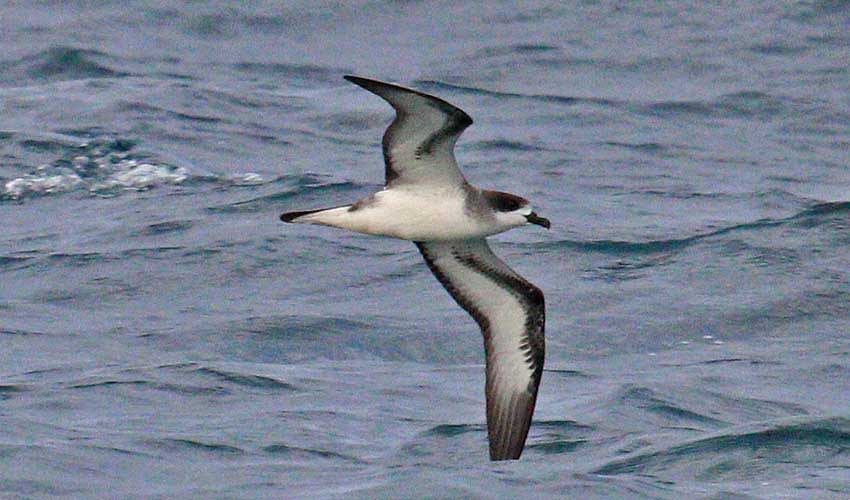
A sleek, wind-loving seabird that spends most of its life over the open Indian Ocean, only returning to land to breed. Its home base is remarkably specific: it nests high in the mountains of Réunion, often on steep, cool slopes where clouds roll in, and the ground stays damp. In flight, it looks built for long journeys—long wings, a streamlined body, and a confident style that mixes smooth glides with quick, purposeful wingbeats. Up close, it has a crisp, two-tone look: pale underparts, darker upperparts, and a bold face pattern that can make it seem masked or hooded, depending on the light.
What makes Barau’s petrel especially distinctive is the unusual combination of a “mountain breeder” and an “ocean wanderer.” Many petrels nest on coastal cliffs or low islands, but this species climbs far inland and high up to raise its young. That alone sets it apart from a lot of its petrel relatives. It also belongs to a group sometimes called “gadfly petrels,” known for fast, agile flight and sharp turns, and Barau’s petrel fits that style perfectly. Compared with close cousins that can look more uniformly dark or more heavily mottled, Barau’s petrel tends to show cleaner contrasts—pale belly, darker back, and a strong head pattern that helps birdwatchers tell it apart when it slices past at speed.
One of the most fascinating (and bittersweet) facts about Barau’s petrel is how lights can confuse it: bright city and street lights can pull young birds off course, causing them to land in places they can’t easily escape. On the brighter side, people on Réunion have organized “petrel rescue” efforts in some areas, collecting grounded birds and releasing them safely. It’s a reminder that Barau’s petrel is both tough and fragile—tough enough to roam an entire ocean, yet still dependent on one mountain home and a safe, dark path to the sea.
Distribution
 Australia
 British Indian T.
 Christmas Island
 Cocos Is. (Keeling)
 Indonesia
 Madagascar
 Mauritius
 Mozambique
 Réunion
 South Africa
 Sri Lanka
Anything we've missed?
Help us improve this page by suggesting edits. Glory never dies!
Suggest an editGet to know me
Terrestrial / Aquatic
Altricial / Precocial
Polygamous / Monogamous
Dimorphic (size) / Monomorphic
Active: Diurnal / Nocturnal
Social behavior: Solitary / Pack / Flock
Diet: Carnivore / Herbivore / Omnivore / Piscivorous / Insectivore
Migratory: Yes / No
Domesticated: Yes / No
Dangerous: Yes / No




