


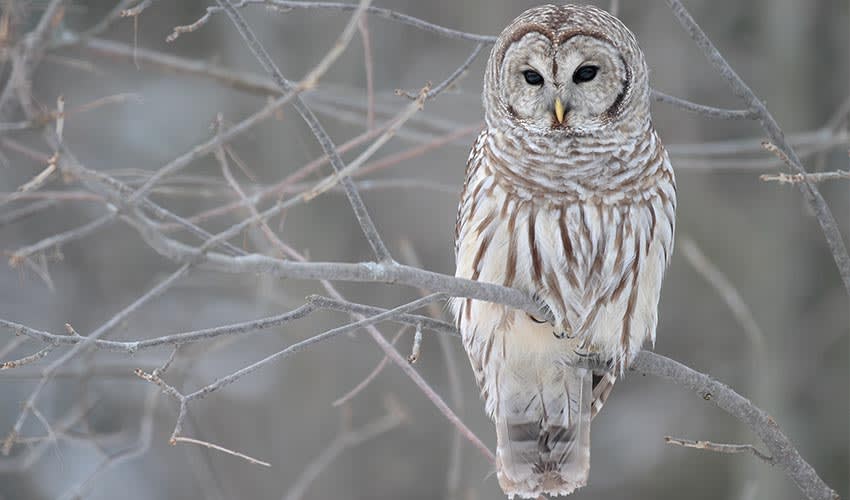
A large, expressive owl commonly found in forests, swamps, and wooded areas across much of North America. It is easy to recognize by its bold pattern of dark bars and streaks across its chest and belly, which gives the bird its name. Its feathers are a mix of brown, gray, and white, creating a soft but striking appearance that blends well with tree bark. The barred owl has a rounded head with no ear tufts and large, dark eyes that give it a curious, almost thoughtful look. It is often seen perched quietly during the day, watching its surroundings from a shaded branch.
One of the most distinctive traits of the barred owl is its voice. Its call is loud, clear, and easy to remember, often described as sounding like a playful question. This call can travel long distances through forests, especially at night, and is one of the best ways to identify the species. Unlike many owls that are strictly active at night, the barred owl is often active at dusk, dawn, and sometimes even during daylight hours. This makes it more visible than many other owls and easier for people to observe in the wild.
The barred owl is also known for its adaptability. While it prefers mature forests with tall trees, it can live in a wide variety of habitats, including wetlands and areas close to human settlements. It is a skilled and flexible hunter, feeding on small mammals, birds, frogs, fish, and even insects. Compared to other large owls, it is less picky about food and hunting locations. Its broad wings allow it to glide smoothly through dense forests, while its sharp hearing helps it locate prey even in low light or thick vegetation.
Distribution
 Bermuda
 Canada
 Mexico
 United States
Anything we've missed?
Help us improve this page by suggesting edits. Glory never dies!
Suggest an editGet to know me
Terrestrial / Aquatic
Altricial / Precocial
Polygamous / Monogamous
Dimorphic (size) / Monomorphic
Active: Diurnal / Nocturnal
Social behavior: Solitary / Pack / Herd
Diet: Carnivore / Herbivore / Omnivore / Piscivorous / Insectivore
Migratory: Yes / No
Domesticated: Yes / No
Dangerous: Yes / No




