


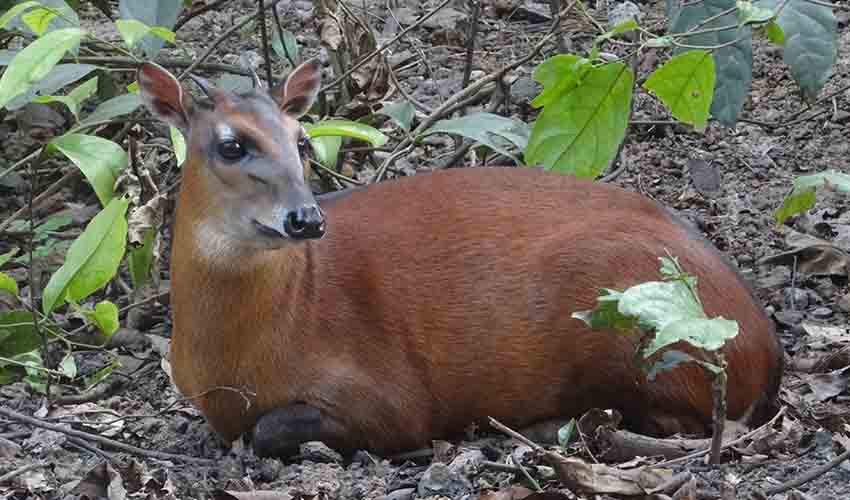
A small, shy forest antelope with a look that’s hard to mistake once you’ve seen it: a rich chestnut-to-reddish coat (often like polished mahogany), a darker stripe running down the back, and a compact body built for slipping through thick undergrowth. It usually stands only about knee-high to an adult human, with short legs, a rounded rump, and a neat, tapered face. Many individuals have a little tuft of hair on the forehead, and the ears tend to be small and alert—perfect for catching faint sounds in a busy rainforest. Males commonly carry short, straight horns, while females are typically hornless, which adds to the duiker’s clean, delicate profile.
What really sets the bay duiker apart from other duikers is its bold, warm coloring and its strong preference for deep, closed-canopy rainforest. Many duiker relatives are gray, brown, or mottled to blend into a wider range of habitats, but the bay duiker’s reddish coat is especially striking—yet still effective in the dim, reddish-brown light of the forest floor. Compared with some of its duiker cousins that tolerate forest edges or mixed landscapes, the bay duiker is more of a true forest specialist, often sticking to dense vegetation where it can vanish in a few steps. It’s also known for being especially hard to spot, not because it’s large and intimidating, but because it’s cautious and tends to freeze or melt into cover rather than dash into the open.
The bay duiker’s daily life is full of clever survival choices. It is mostly active during the dimmer hours—early morning, late afternoon, and sometimes at night—when the forest is quieter, and shadows are thick. Its menu is wonderfully flexible: it eats fallen fruit, leaves, buds, and fungi, and it will sometimes sample other small forest finds when available. In a way, it works like a living clean-up crew, helping “recycle” forest food that drops to the ground.
Distribution
 Angola
 Cameroon
 Central Af. Rep.
 Congo-Brazzaville
 Côte D’ivoire
 DR Congo (Kinshasa)
 Equatorial Guinea
 Gabon
Gabon Ghana
Ghana Guinea-Bissau
 Guinea
 Liberia
 Nigeria
 Sierra Leone
 Togo
Togo Uganda
 Official estimate
Anything we've missed?
Help us improve this page by suggesting edits. Glory never dies!
Suggest an editGet to know me
Terrestrial / Aquatic
Altricial / Precocial
Polygamous / Monogamous
Dimorphic (size) / Monomorphic
Active: Diurnal / Nocturnal
Social behavior: Solitary / Pack / Herd
Diet: Carnivore / Herbivore / Omnivore / Piscivorous / Insectivore
Migratory: Yes / No
Domesticated: Yes / No
Dangerous: Yes / No




