


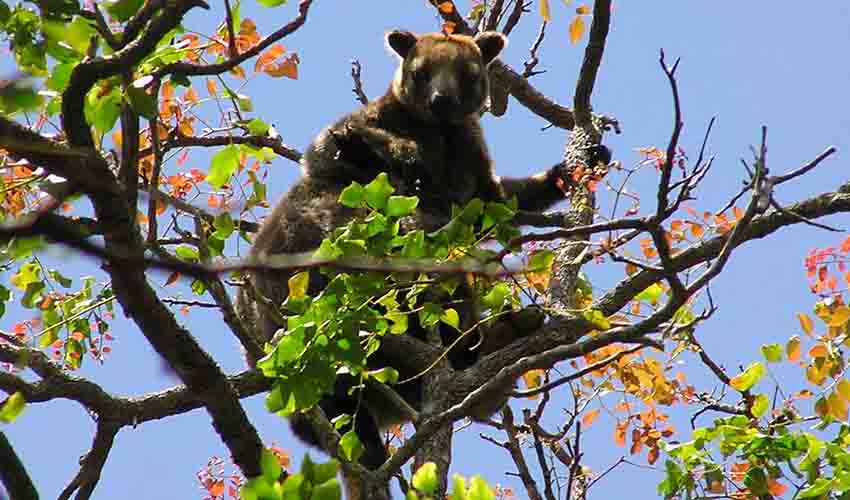
Native to northeastern Queensland, Australia, it looks like a solid, plush-bodied climber with a warm, reddish-brown coat that suits the colors of bark, dead leaves, and filtered sunlight. Its body is compact and strong, with forelimbs that do a lot of pulling and gripping, and feet armed with sturdy claws for clinging to trunks and branches. The long tail is a built-in balancing tool—less “springy kangaroo tail,” more “tightrope pole”—helping it stay steady as it moves through the canopy. Up close, it can seem almost teddy-bear-like in shape, but its calm appearance hides serious athletic gear designed for a vertical life.
Bennett’s is often described as the larger, more “russet” of Australia’s tree-kangaroos, with a richer reddish coat and a generally sturdier presence. Where Lumholtz’s is strongly tied to cooler, high, misty forests, Bennett’s is more often associated with lower to mid-elevation rainforests and forest edges, making it feel like the canopy’s adaptable resident rather than a strictly upland specialist. Among tree-kangaroos as a group (many of which live in New Guinea and can have bold patterns or striking contrasts), Bennett’s tends to keep it simple: a classic, earthy color palette that helps it disappear into the rainforest backdrop.
Watching how it moves is where the “tree-kangaroo” idea really clicks. On the ground, it can look a bit out of place—like a climber forced to do a sprint—because its body is tuned for gripping rather than racing. But once it’s among trunks and branches, it becomes a careful expert. It climbs with deliberate strength, hugging the tree and shifting weight slowly, as if it’s constantly checking the next handhold. It can also make impressive jumps between branches when needed, using strong legs and balance rather than the long, open bounding that field kangaroos do.
Distribution
 Australia
Anything we've missed?
Help us improve this page by suggesting edits. Glory never dies!
Suggest an editGet to know me
Terrestrial / Aquatic
Altricial / Precocial
Polygamous / Monogamous
Dimorphic (size) / Monomorphic
Active: Diurnal / Nocturnal
Social behavior: Solitary / Pack / Herd
Diet: Carnivore / Herbivore / Omnivore / Piscivorous / Insectivore
Migratory: Yes / No
Domesticated: Yes / No
Dangerous: Yes / No




