


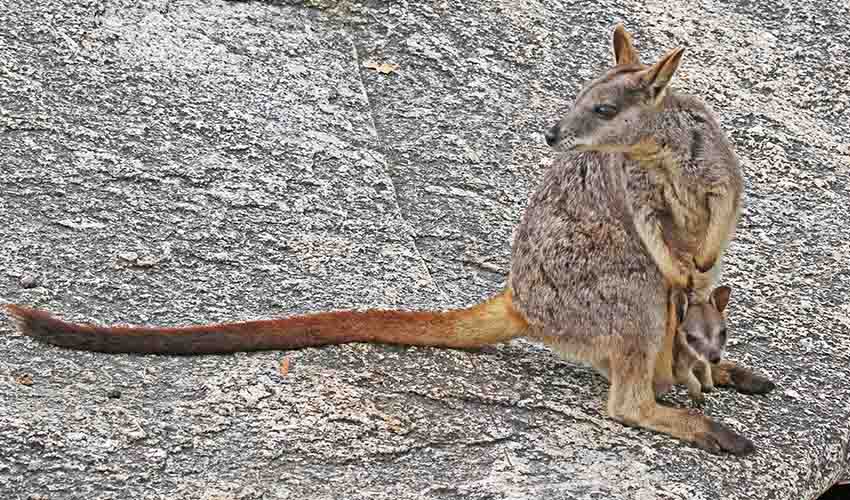
A tough little cliff-dweller from northeastern Queensland, Australia, built for a life where the ground is mostly stone and the best escape route is straight up. It lives around rocky outcrops, boulder fields, and steep slopes—places where caves, cracks, and shaded ledges offer shelter from heat and danger. Like other rock-wallabies, it has powerful back legs for springy leaps, forepaws that can brace and steady it on uneven surfaces, and a long tail that acts like a balancing pole when it lands on slanted rock. Its coat is generally earthy and practical—gray-browns and warm browns that match the tones of rock and dry leaf litter—so when it freezes in the right spot, it can blend in like part of the landscape.
Rock-wallabies can look similar at first glance, but each species tends to be linked to specific regions and rock systems, almost like different neighborhoods in a vast stone city. The Mareeba rock-wallaby’s world is one of local rocky refuges rather than wide-open plains, and that shapes everything about it: it’s not built for long-distance travel across flat country, but for short, precise movements between safe hideouts and nearby feeding spots. Its look is more about function than flash—less “striped showpiece,” more “quiet professional”—but that understated style is exactly what helps it survive among mottled shadows and sunlit stone.
Daily life is a careful rhythm of hiding, feeding, and using terrain as armor. During the hottest parts of the day, a Mareeba rock-wallaby will often rest in cool crevices, under overhangs, or deep in boulder piles where the temperature can feel dramatically lower than the open hillside. When late afternoon arrives and the air begins to soften, it becomes more active, edging out to browse on grasses, leaves, and small shrubs.
Distribution
 Australia
 Official estimate
Anything we've missed?
Help us improve this page by suggesting edits. Glory never dies!
Suggest an editGet to know me
Terrestrial / Aquatic
Altricial / Precocial
Polygamous / Monogamous
Dimorphic (size) / Monomorphic
Active: Diurnal / Nocturnal
Social behavior: Solitary / Pack / Herd
Diet: Carnivore / Herbivore / Omnivore / Piscivorous / Insectivore
Migratory: Yes / No
Domesticated: Yes / No
Dangerous: Yes / No




