


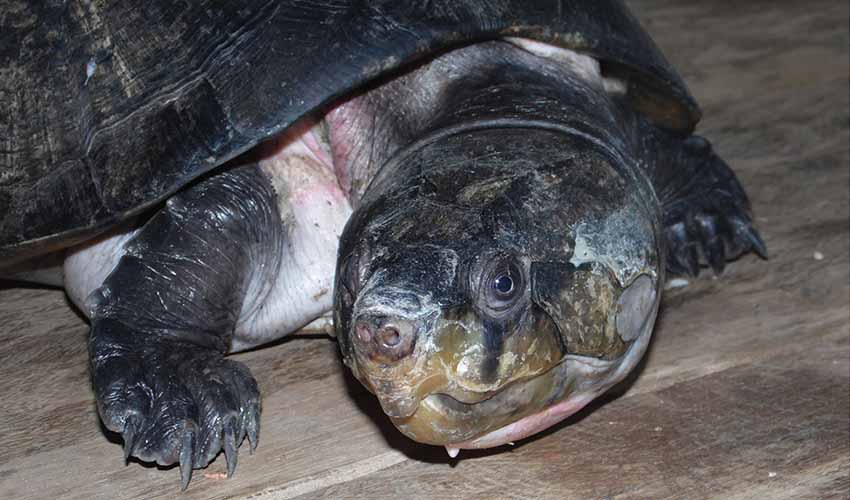
Looks like it swam straight out of a time machine from the age of dinosaurs — sturdy, ancient, and undeniably imposing. As its name boldly suggests, it sports a massive, muscular head paired with a solid, domed shell, making it one of the most distinctive turtles in the Amazon. Its build is powerful and rugged, a design perfectly suited for life in the mysterious, tea-colored waters of the Amazon Basin.
This species ranges across Brazil, Colombia, Peru, Ecuador, and Venezuela, preferring slow rivers, flooded forests, and quiet blackwater creeks. Unlike many turtles that bask in sunlight, the Big-headed Amazon river turtle keeps a low profile. It’s mostly nocturnal, emerging at night to patrol the river bottom while the world sleeps. With a bite that means business, it feeds on snails, crustaceans, aquatic insects, and fallen fruits, using its formidable jaws to crush hard shells with ease. It may look like a bruiser, but it’s surprisingly shy — opting to lurk in root tangles, submerged log piles, and deep pools rather than parading about in the open.
Life begins on sandy riverbanks during the dry season, when females dig nests above flood lines and deposit their eggs in carefully chosen spots. The hatchlings that emerge months later are tiny but already “big-headed,” like miniature versions of the adults. They must immediately navigate a water world full of predators, which is why this species keeps a secretive nature from day one. While still relatively widespread, the species is pressured by hunting and egg collection, making healthy habitats and responsible stewardship vital to its long-term survival.
Distribution
 Brazil
 Colombia
 Ecuador
 French Guiana
 Peru
Peru Venezuela
Anything we've missed?
Help us improve this page by suggesting edits. Glory never dies!
Suggest an editGet to know me
Terrestrial / Aquatic
Altricial / Precocial
Polygamous / Monogamous
Dimorphic (size) / Monomorphic
Active: Diurnal / Nocturnal
Social behavior: Solitary / Pack / Herd
Diet: Carnivore / Herbivore / Omnivore / Piscivorous / Insectivore
Migratory: Yes / No
Domesticated: Yes / No
Dangerous: Yes / No




