


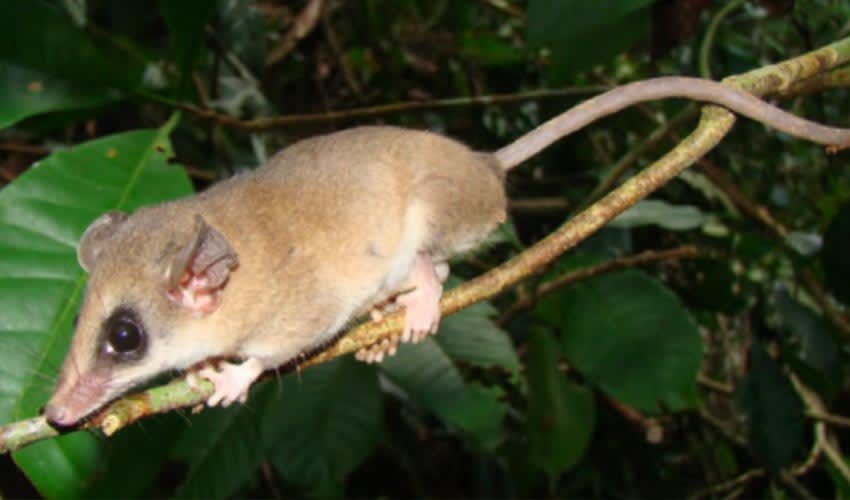
As the name suggests, it’s noticeably slender compared with many other opossums, with a narrow body, a long pointed snout, and a long tail that’s mostly bare and flexible. Its fur is usually brownish to gray-brown, often with paler tones underneath, giving it a soft, earthy look that blends into bark, dried leaves, and shadowy understory. The eyes are large and dark, perfect for moving at night, and the ears are thin and alert, always ready to catch faint sounds. Overall, it gives off a “quiet explorer” vibe—more like a careful climber than a bold scavenger.
When someone says “opossum,” they often imagine a much larger animal that scavenges near roadsides or dumpsters. Bishop’s slender opossum belongs to a different crowd: the slender opossums, which are generally smaller, more delicate, and more closely tied to forest life. It’s the kind of marsupial that can move along thin branches and vines where heavier animals would struggle. Its light build helps it move through shrubs and low trees with less noise and less branch shaking—an advantage when you want to avoid predators and sneak up on prey.
Bishop’s slender opossum is an opportunistic eater, but in a more “small hunter” way than a “big scavenger” way. Insects and other small prey are important, and it may also eat fruit or other easy forest snacks when it finds them. It uses smell, hearing, and careful sniffing to track food, often pausing as if it’s listening for tiny movements in leaves. Because it’s small, it doesn’t rely on brute strength; it relies on stealth. When threatened, it can freeze, flatten itself against a branch, or slip into thick vegetation rather than charging away in a loud dash. During the day, it rests in sheltered spots—dense foliage, vine tangles, tree hollows, or other tucked-away hideouts that keep it out of sight and help it stay safe.
Distribution
 Bolivia
 Brazil
 Peru
PeruAnything we've missed?
Help us improve this page by suggesting edits. Glory never dies!
Suggest an editGet to know me
Terrestrial / Aquatic
Altricial / Precocial
Polygamous / Monogamous
Dimorphic (size) / Monomorphic
Active: Diurnal / Nocturnal
Social behavior: Solitary / Pack / Herd
Diet: Carnivore / Herbivore / Omnivore / Piscivorous / Insectivore
Migratory: Yes / No
Domesticated: Yes / No
Dangerous: Yes / No




