


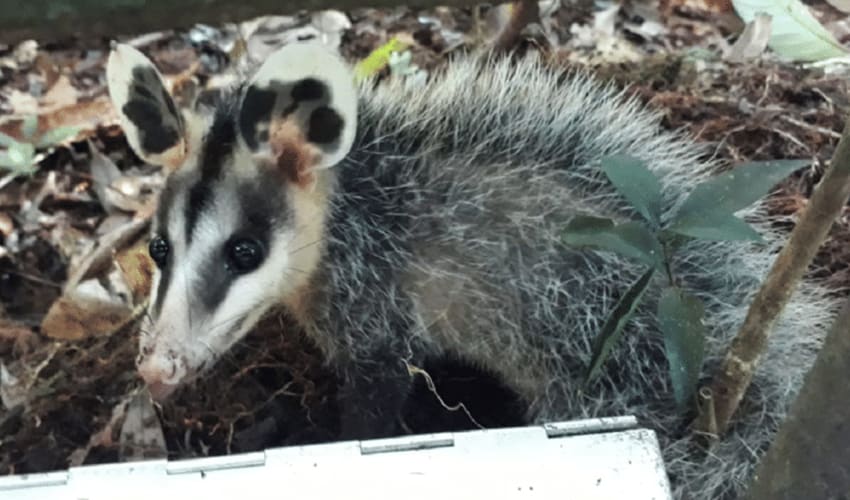
A tough little nighttime wanderer from the Guiana Shield region of northern South America, and it wears its best ID badge right on its head: pale, whitish ears that stand out against a darker face. It has the classic opossum look—pointed snout, bright eyes, and a tail that’s mostly bare and scaly—plus a sturdy, “built to scramble” body for climbing and clambering through branches, vines, and messy forest edges. Its coat is usually gray to dark gray-brown, with a lighter underside, a coloring that makes it blend into bark and shadows. When it moves, it’s less about speed and more about careful confidence: a stop to sniff, a pause to listen, then a quiet climb or a soft-footed trot along a fallen log.
Many people think “opossum” and picture the North American Virginia opossum, but this is a South American species with a much more limited home base. In fact, among its close Didelphis relatives, it’s known for having one of the smallest ranges, tied largely to the Guiana Shield and nearby areas. It also overlaps in the “look-alike” category with other opossums that may have pale ears or similar gray coats, so its combination of location, ear color, and overall “forest-shadow” look becomes important. In places where several opossum species can occur, this one often feels like the local specialist—more associated with the Guianas’ forest belt than the wide-ranging, everywhere-at-once reputation some other opossums have.
In daily life, it’s an adaptable eater with a practical attitude: fruit when it’s available, insects and other small prey when it can catch them, and plenty of opportunistic snacking if something easy turns up. That flexible menu helps it survive in changing conditions, from thick forest to edges near people, as long as there’s cover to retreat into. It’s mostly active from dusk through the night, using smell and hearing to navigate a world that’s more about rustles than views.
Distribution
 Brazil
 French Guiana
 Guyana
 Suriname
 Venezuela
Anything we've missed?
Help us improve this page by suggesting edits. Glory never dies!
Suggest an editGet to know me
Terrestrial / Aquatic
Altricial / Precocial
Polygamous / Monogamous
Dimorphic (size) / Monomorphic
Active: Diurnal / Nocturnal
Social behavior: Solitary / Pack / Herd
Diet: Carnivore / Herbivore / Omnivore / Piscivorous / Insectivore
Migratory: Yes / No
Domesticated: Yes / No
Dangerous: Yes / No




