


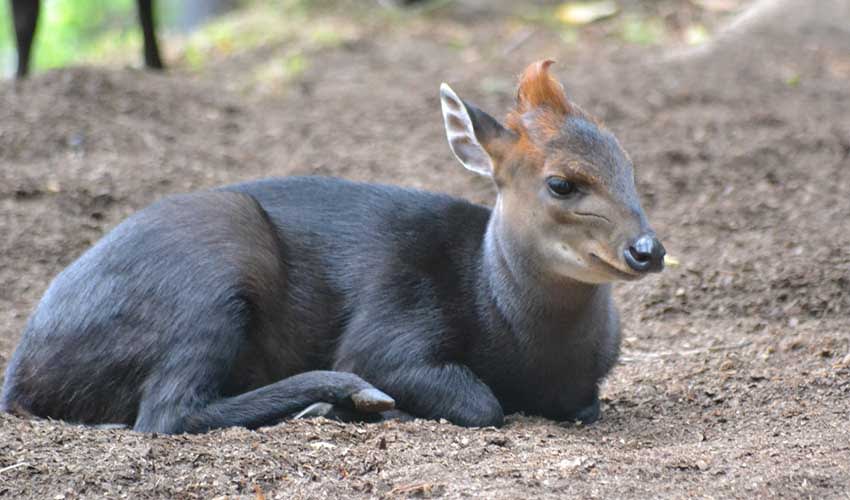
One of West Africa’s most distinctive and elusive forest antelopes, known for its sleek dark coat, shy nature, and preference for dense rainforest habitat. Found primarily in Sierra Leone, Liberia, Côte d’Ivoire, and Ghana, this duiker is a specialist of lowland and mid-elevation forests where thick vegetation offers cover, browse, and safety. Like most duikers, it is secretive and solitary, slipping quietly through the shadows of the understory and rarely revealing itself for more than a moment.
The black duiker gets its name from its deep black or dark chestnut-brown coat, which contrasts sharply with the brighter colors seen in many of its relatives. This melanistic appearance is not only striking but also highly practical. In dim rainforest conditions, the dark coat helps it blend seamlessly into shadows, roots, tree trunks, and thickets. Its underparts are slightly lighter, and the face is streamlined with delicate features and large, expressive eyes adapted for low-light vision. Both males and females have short, backward-curving horns that are often hidden by a tuft of hair on the forehead, though males tend to have slightly longer horns.
The back duiker is a small to medium-sized duiker. Its body is compact and muscular, with strong legs adapted for quick dashes through tangled vegetation. True to the duiker name—derived from a word meaning “diver”—the species has a habit of darting forward and “diving” into dense cover when alarmed.
Diet-wise, the Black duiker is a browser and frugivore, feeding on leaves, fallen fruit, buds, flowers, shoots, seeds, and occasionally fungi. Like many duikers, it depends heavily on fruit from the forest canopy dropped by monkeys, hornbills, and other arboreal animals. This feeding strategy makes it an important seed disperser, contributing to forest regeneration and plant diversity. It often forages at dusk, dawn, and during the night, relying on smell and hearing to locate food in the dim forest understory.
Distribution
 Côte D’ivoire
 Ghana
Ghana Guinea
 Liberia
 Nigeria
 Sierra Leone
 Togo
TogoAnything we've missed?
Help us improve this page by suggesting edits. Glory never dies!
Suggest an editGet to know me
Terrestrial / Aquatic
Altricial / Precocial
Polygamous / Monogamous
Dimorphic (size) / Monomorphic
Active: Diurnal / Nocturnal
Social behavior: Solitary / Pack / Herd
Diet: Carnivore / Frugivore / Omnivore / Piscivorous / Insectivore
Migratory: Yes / No
Domesticated: Yes / No
Dangerous: Yes / No




