


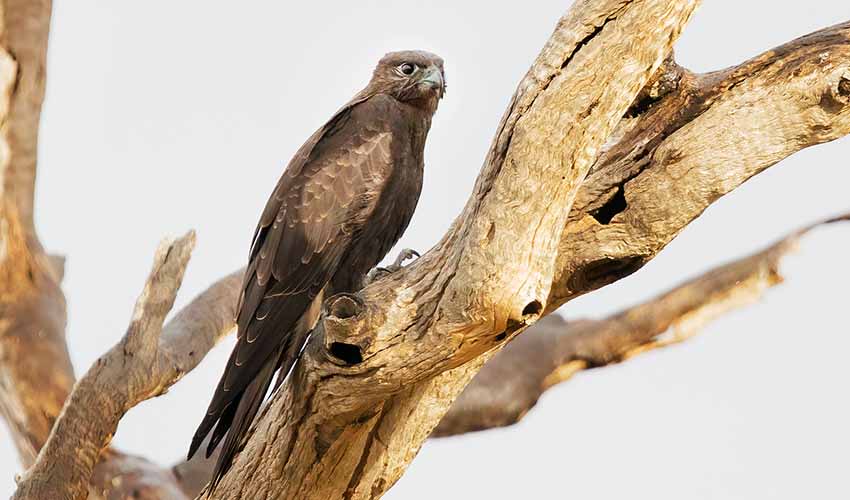
At first glance, it looks almost entirely black as it soars across open skies, which is how it earned its name, but a closer look shows rich chocolate-brown feathers that catch the sunlight. Its long, pointed wings and slender build give it a sleek, aerodynamic shape that is very different from that of stockier raptor species. Because it is naturally quiet and tends to avoid heavily populated areas, the black falcon often goes unnoticed, even in places where it is common.
Unlike many falcons that prefer cliffs or dense forests, the black falcon thrives in wide-open landscapes—grasslands, plains, farmland, and semi-desert areas. This preference for open country affects almost every part of its behavior. It hunts mostly on the wing, chasing down fast-moving birds in long, thrilling aerial pursuits. While other falcons, such as the Peregrine falcon, rely heavily on dramatic high-speed dives, the black falcon often uses long-distance chases and sudden bursts of acceleration to grab its prey midair. Its flying style is smooth but powerful, with long glides that suddenly snap into rapid wingbeats.
Another trait that sets the black falcon apart is its mysterious nature. It is surprisingly understudied compared to other falcons, and researchers still have questions about its breeding habits, population size, and long-term trends. Part of this mystery comes from its habit of reusing old stick nests built by crows or ravens rather than building its own. While some falcons nest on cliffs or in tree hollows, the black falcon chooses these borrowed nests in tall trees, making it adaptable but harder to track. Pairs are usually loyal to their nesting sites, returning year after year to raise their chicks. However, because they prefer remote, open regions, scientists don’t always get the chance to observe them closely. This secrecy gives the species an air of quiet independence that birdwatchers find intriguing.
Distribution
 Australia
 New Zealand
Anything we've missed?
Help us improve this page by suggesting edits. Glory never dies!
Suggest an editGet to know me
Terrestrial / Aquatic
Altricial / Precocial
Polygamous / Monogamous
Dimorphic (size) / Monomorphic
Active: Diurnal / Nocturnal
Social behavior: Solitary / Pack / Herd
Diet: Carnivore / Herbivore / Omnivore / Piscivorous / Insectivore
Migratory: Yes / No
Domesticated: Yes / No
Dangerous: Yes / No




