


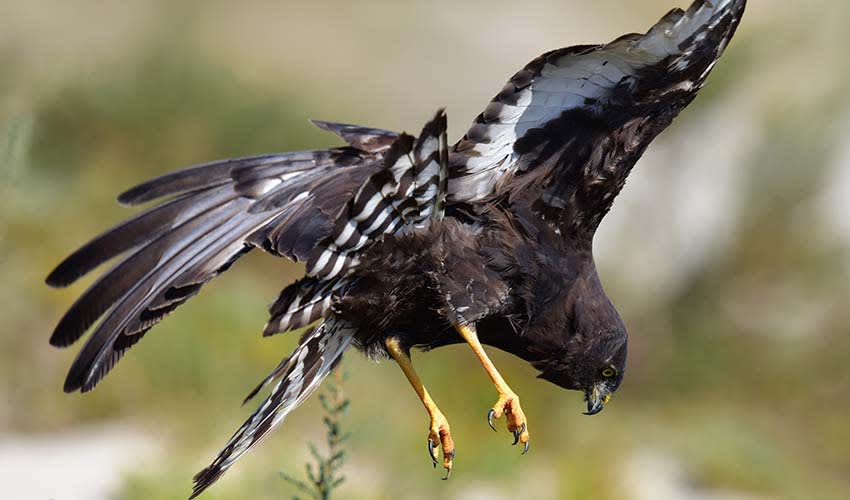
Found mainly in southern Africa, it’s most closely tied to the coastal lowlands and shrublands of South Africa, where it glides low over fynbos, dunes, grassland edges, and farmlands. At a glance, adults are striking: a mostly charcoal-to-black body contrasted by a crisp white rump that flashes like a signal flag when the bird banks or turns. It has narrow wings and a long tail, giving it an elegant, buoyant flight style—more “floating and tilting” than flapping hard.
Harriers are famous for working the landscape like a living drone, quartering back and forth in neat lines. The black harrier does this with patience, using its excellent hearing and eyesight to pinpoint prey. Small mammals are a major part of its diet—especially rodents—along with small birds, reptiles, and large insects when available. You’ll often see it hunting in the early morning or late afternoon when prey is active, and light is softer. Its face has a subtle “owl-like” look that helps funnel sound toward the ears, which is handy when prey is hidden under grass or low shrubs. Compared with many hawks that rely on surprise dives from high perches, the black harrier is more of a slow, methodical searcher, using low altitude and steady coverage to win the day.
In breeding season, the black harrier becomes even more interesting. It usually nests on the ground in dense vegetation—an unusual choice for a large raptor, but a practical one in wide, treeless landscapes. A pair will defend a nesting area and often use dramatic aerial displays: swooping, circling, and passing food mid-air in a quick handoff that looks like a stunt. The female tends to be heavier and broader than the male, a common pattern in birds of prey, and that size difference helps divide roles: the male often does more hunting and delivers food, while the female focuses on guarding the nest and caring for chicks.
Distribution
 Botswana
 Eswatini
 Lesotho
 Namibia
 South Africa
Anything we've missed?
Help us improve this page by suggesting edits. Glory never dies!
Suggest an editGet to know me
Terrestrial / Aquatic
Altricial / Precocial
Polygamous / Monogamous
Dimorphic (size) / Monomorphic
Active: Diurnal / Nocturnal
Social behavior: Solitary / Pack / Herd
Diet: Carnivore / Herbivore / Omnivore / Piscivorous / Insectivore
Migratory: Yes / No
Domesticated: Yes / No
Dangerous: Yes / No




