


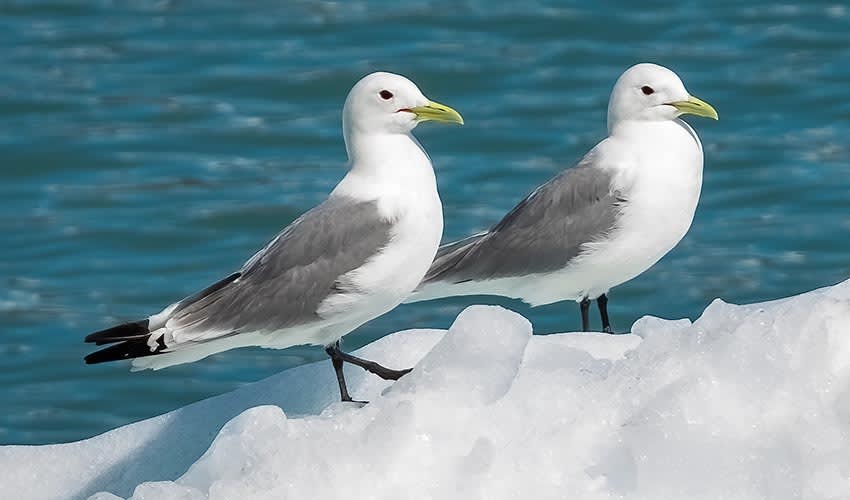
While other gulls are happy to loiter around parking lots or beaches, the kittiwake is a true oceanic specialist that spends its winters in the middle of the North Atlantic and North Pacific, only coming to land to nest on the steepest, most vertical sea cliffs imaginable. Physically, they are beautiful, medium-sized gulls with a clean white head, a soft grey back, and “dipped-in-ink” black wingtips. What technically separates them from almost all other gulls is their legs: they are solid, jet black, and their hind toe is either completely missing or reduced to a tiny bump—a specialized adaptation for a life spent clinging to narrow rock ledges rather than walking on flat ground.
What truly sets the kittiwake apart is its “polite” nesting etiquette. Because they live on tiny, precarious ledges, they can’t afford to be as rowdy or mobile as ground-nesting gulls. Their nests are architectural marvels made of mud, seaweed, and guano, which they “tamp down” with their feet to create a solid, glued-on platform. Unlike other gull chicks that wander around and explore, Kittiwake chicks sit perfectly still. They have a deep-seated instinct to face the cliff wall and stay put; one wrong step or a playful hop would result in a 200-foot plunge into the icy sea below.
The “humanized” side of this bird is its name, which is a perfect example of “onomatopoeia.” They are incredibly vocal, and their primary call is a loud, rhythmic “kitti-wa-ak! kitti-wa-ak!” that echoes off the cliff faces. In a massive colony of thousands of birds, the sound is deafening—a constant, cheering roar that defines the atmosphere of the Arctic and subarctic coastlines. They are also much more “dapper” than other gulls; they have a bright lemon-yellow bill that is smooth and lacks the red “spot” found on many larger gulls, giving them a very clean, refined appearance.
Distribution
 Afghanistan
 Algeria
 Antigua & Barbuda
 Austria
 Bahamas
 Barbados
 Belarus
 Belgium
 Belize
 British Virgin Is.
 Bulgaria
 Canada
 Cape Verde
 Cayman Islands
 China
China Croatia
 Cuba
Cuba Cyprus
 Czechia
 Côte D’ivoire
 Denmark
 Dominica
 Dominican Republic
 Egypt
Egypt Estonia
 Faroe Islands
 France
 Gambia
 Germany
 Gibraltar
 Greece
 Greenland
Guadeloupe
Greenland
Guadeloupe Guinea-Bissau
 Guinea
 Haiti
Haiti Hungary
 Iceland
 Iran
Iran Ireland
 Israel
 Italy
Italy Jamaica
 Japan
Japan Jordan
 Kazakhstan
 Korea
Korea Kyrgyzstan
 Latvia
 Lebanon
 Liberia
 Lithuania
 Luxembourg
 Malta
Martinique
Malta
Martinique Mauritania
 Mexico
 Monaco
 Mongolia
 Montenegro
 Montserrat
 Morocco
 Netherlands
 North Korea
 North Macedonia
 Norway
 Oman
Oman Peru
Peru Poland
 Portugal
 Puerto Rico
 Romania
 Russia
 Saint Lucia
 Saint Pierre
 Saint Vincent
 Senegal
 Serbia
 Sierra Leone
 Slovakia
 Slovenia
 South Africa
 Spain
Spain St. Kitts & Nevis
Svalbard
St. Kitts & Nevis
Svalbard Sweden
 Switzerland
 Syria
Syria Trinidad & Tobago
 Tunisia
 Turks & Caicos
 Turkey
 UAE
UAE US Virgin Islands
 Ukraine
 United Kingdom
 United States
 Uzbekistan
Anything we've missed?
Help us improve this page by suggesting edits. Glory never dies!
Suggest an editGet to know me
Terrestrial / Aquatic
Altricial / Precocial
Polygamous / Monogamous
Dimorphic (size) / Monomorphic
Active: Diurnal / Nocturnal
Social behavior: Solitary / Pack / Flock
Diet: Carnivore / Herbivore / Omnivore / Piscivorous / Insectivore
Migratory: Yes / No
Domesticated: Yes / No
Dangerous: Yes / No




