


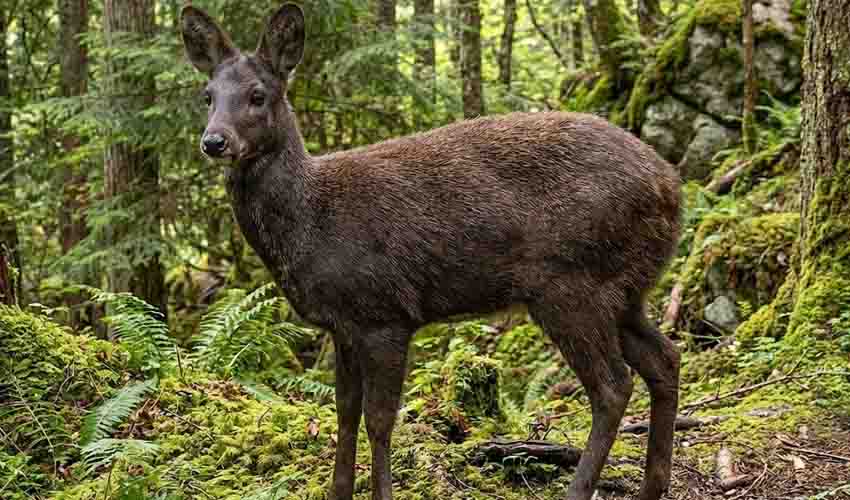
A shy, mountain-dwelling animal that looks a bit like a deer, but with a wilder edge. It has a compact body, long, slender legs built for steep ground, and a thick coat that can appear very dark brown to almost black, especially along the back—one reason for its name. Its face is narrow and alert, with large ears that swivel to catch the faintest sound in dense forest. Unlike what most deer people picture, it has no antlers at all. Instead, males have long upper canine teeth that can stick out like small fangs, giving this quiet plant-eater an unexpectedly fierce look up close.
What truly distinguishes the black musk deer from true deer is that it belongs to the musk deer group, not the deer family. Musk deer are famous for relying on scent rather than antlers or loud calls. Adult males have a special gland that produces musk, a strong-smelling substance used mainly for communication, especially during breeding season. Think of it as a powerful “name tag” that can travel through a forest better than sound or sight. In thick mountain woods where visibility is short, scent messages last longer and reach farther, so musk deer are built for a world of smells. They also tend to be solitary rather than herd animals, which makes them feel more like forest ghosts than meadow grazers.
The black musk deer’s home adds another layer of distinction. It is associated with rugged Asian mountain regions where forests can be dense, and the terrain can be unforgiving—steep slopes, tangled shrubs, and cold winters. In this kind of habitat, speed across open ground matters less than quiet movement and knowing escape routes. A black musk deer often uses the same narrow trails through vegetation, like secret corridors, and it may freeze completely when it senses danger, trusting camouflage and stillness over panic running. It is mainly active in dim hours—dawn, dusk, and night—when shadows make it harder for predators and people to spot. Its diet is made up of plant material: leaves, shoots, grasses, and other vegetation available near the forest floor, with choices shifting by season and altitude.
Distribution
 Bhutan
 China
China India
India Myanmar
 Nepal
NepalAnything we've missed?
Help us improve this page by suggesting edits. Glory never dies!
Suggest an editGet to know me
Terrestrial / Aquatic
Altricial / Precocial
Polygamous / Monogamous
Dimorphic (size) / Monomorphic
Active: Diurnal / Nocturnal
Social behavior: Solitary / Pack / Herd
Diet: Carnivore / Herbivore / Omnivore / Piscivorous / Insectivore
Migratory: Yes / No
Domesticated: Yes / No
Dangerous: Yes / No




