


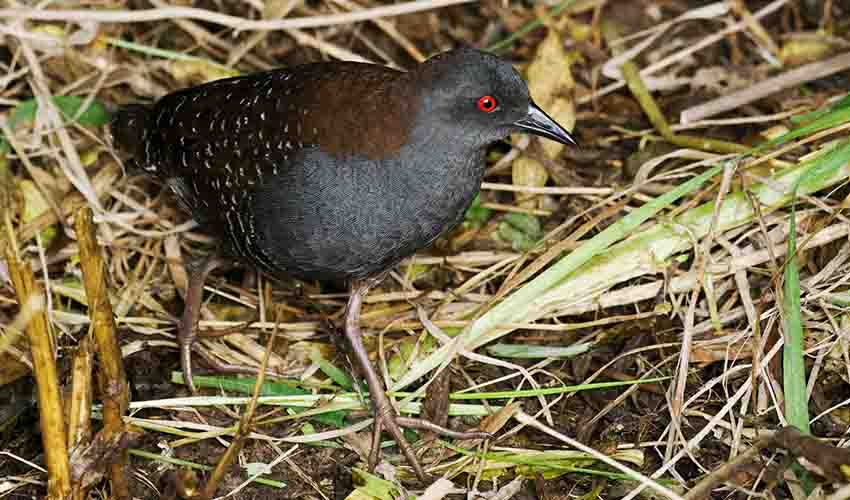
One of the most secretive birds in the Americas—small enough to fit in your hand, but legendary among birdwatchers because it can live right beside people and still remain almost invisible. It’s about sparrow-sized, with a short tail, a compact body, and long toes that help it walk on soft, soggy ground without sinking. True to its name, much of its feathers are dark charcoal to black, sprinkled with tiny white spots that look like starlight. When it moves, it often does so like a mouse: quick, low, and hugging cover.
What makes the black rail stand out from other rails is its small size, quietness, and stealth. Many rails are larger, louder, and more willing to step into open mud or along shorelines. The black rail prefers thick, low vegetation where the ground is wet but not too deep—places with a mix of shallow water, muddy edges, and dense plants that form a roof over tiny tunnels. It’s also a champion at staying low: instead of flying at the first sign of trouble, it often freezes, slips behind a clump of grass, or runs through narrow pathways it seems to know by heart. Its coloring helps too—those white speckles break up its outline, so even if it’s only a few feet away, it can look like shadow and reeds rather than a bird.
The black rail’s daily life is all about careful searching and quick snacks. It eats small creatures it can grab on the move—tiny crabs, insects, spiders, snails, and other bite-sized marsh life—often picking through damp edges or leaf litter where food is plentiful. Because it relies on thick cover, it can be sensitive to big changes in water levels. Too dry, and its marsh turns into brittle grass; too flooded, and its hidden pathways disappear.
Distribution
 Antigua & Barbuda
 Argentina
 Bahamas
 Belize
 Bermuda
 Brazil
 Chile
Chile Colombia
 Costa Rica
 Cuba
Cuba Dominican Republic
 Guatemala
 Official estimate
 Haiti
Haiti Honduras
 Jamaica
 Mexico
 Panama
 Peru
Peru Puerto Rico
 US Virgin Islands
 United States
Anything we've missed?
Help us improve this page by suggesting edits. Glory never dies!
Suggest an editGet to know me
Terrestrial / Aquatic
Altricial / Precocial
Polygamous / Monogamous
Dimorphic (size) / Monomorphic
Active: Diurnal / Nocturnal
Social behavior: Solitary / Pack / Herd
Diet: Carnivore / Herbivore / Omnivore / Piscivorous / Insectivore
Migratory: Yes / No
Domesticated: Yes / No
Dangerous: Yes / No




