


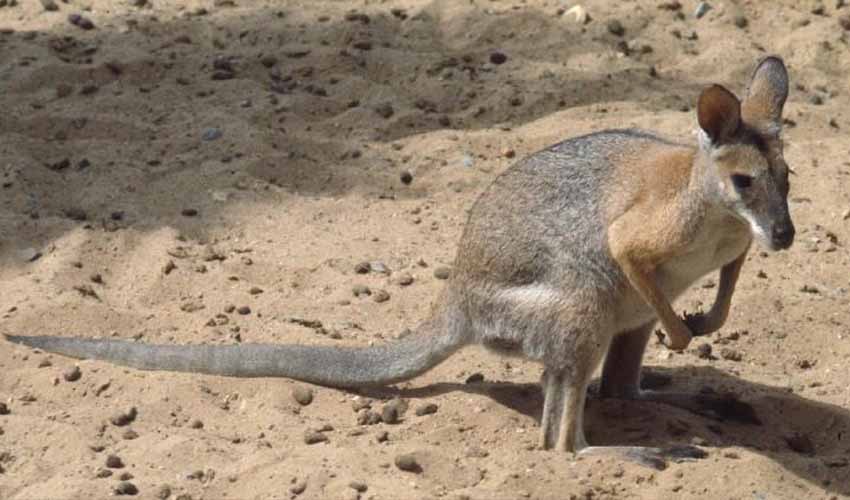
A master of subtle style: at first glance, it looks like a typical wallaby—compact, alert, and ready to spring—but then you notice its signature detail, a dark stripe running along its back like a racing line. That stripe is the giveaway, setting it apart from many other wallabies that rely more on speckles, patches, or plain sandy coats. Its fur is usually a warm mix of browns and grays, made to blend into grasses, leaf litter, and scrub, while the stripe adds a crisp contrast that looks almost painted on.
What really distinguishes the black-striped wallaby from other wallabies isn’t just the stripe, but the way it lives: it’s often more secretive than you’d expect from such a clearly marked animal. Instead of hanging out openly in big mobs, it tends to keep a low profile, favoring cover and moving when the light is softer—early morning, late afternoon, and night. In areas where several wallaby species can share the same general region, this “stay hidden, move quietly” approach helps it avoid trouble and competition. The stripe itself likely helps break up its outline in dappled shade, especially when it’s sitting still among grasses and thin tree shadows.
Its daily routine is all about smart timing and quick decisions. Feeding is largely a plant-based affair—grasses, herbs, and tender shoots—so it spends a lot of time quietly grazing and nibbling, pausing often to listen. When danger shows up, it doesn’t always bolt immediately; one of its most effective tricks is to freeze and let its camouflage do the work, then spring away in a sudden, zigzagging escape if the threat gets closer. Those powerful hops aren’t just about speed—they’re also about efficiency, letting it travel across rough ground while using less effort than constant running.
Distribution
 Australia
Anything we've missed?
Help us improve this page by suggesting edits. Glory never dies!
Suggest an editGet to know me
Terrestrial / Aquatic
Altricial / Precocial
Polygamous / Monogamous
Dimorphic (size) / Monomorphic
Active: Diurnal / Nocturnal
Social behavior: Solitary / Pack / Herd
Diet: Carnivore / Herbivore / Omnivore / Piscivorous / Insectivore
Migratory: Yes / No
Domesticated: Yes / No
Dangerous: Yes / No




