


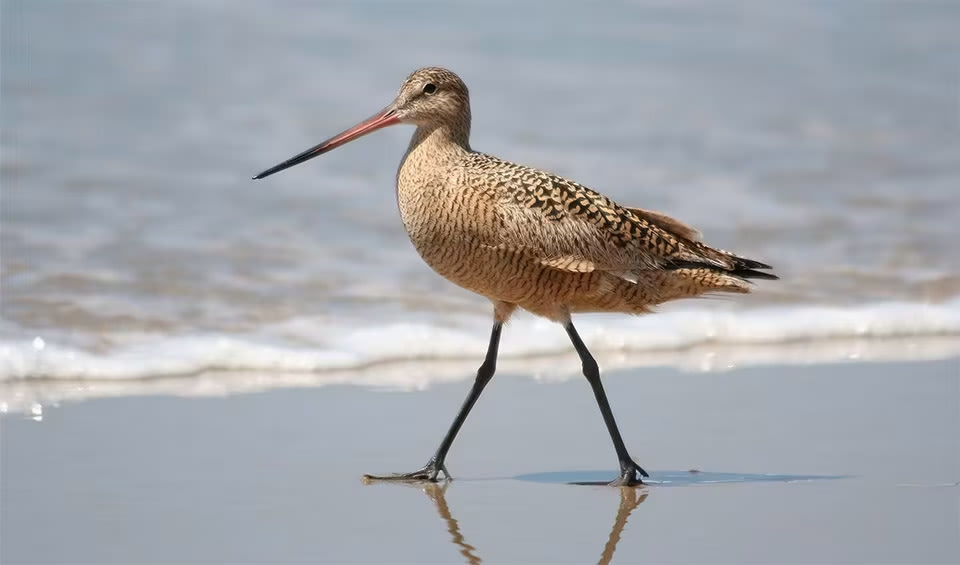
A magnificent member of the sandpiper family, stands out with its imposing stature, long legs, and distinctive long, straight beak. Renowned for its elegant appearance, it is often considered the most aesthetically pleasing among the four godwit species.
Breeding in both boreal and low arctic regions, the Black-tailed Godwit embarks on remarkable migratory journeys southward following the mating season. Across its range, which spans various continents, three distinct subspecies of the Black-tailed Godwit have been identified, each exhibiting similar distribution patterns.
Despite its striking beauty and remarkable migratory feats, the Black-tailed Godwit faces a myriad of threats that jeopardize its survival. Habitat loss and degradation in its breeding areas pose significant challenges, exacerbated by disturbances resulting from alterations to these critical habitats. Additionally, predation, hunting, pollution, and habitat fragmentation further compound the species’ vulnerability, placing it at risk of extinction.
As opportunistic feeders, Black-tailed Godwits exhibit a diverse diet comprising a wide array of invertebrates and plant matter. From insects and their larvae to annelids, mollusks, crustaceans, and marine worms, these birds display remarkable versatility in their foraging habits. Additionally, they opportunistically consume spiders, fish eggs, berries, and seeds, with rice being a prominent component of their diet in certain regions.
Distribution
 Afghanistan
 Albania
 Algeria
 Andorra
 Armenia
 Australia
 Austria
 Azerbaijan
 Bahrain
 Bangladesh
 Belarus
 Belgium
 Benin
Benin Bosnia And Herz.
 Botswana
 Brunei
 Bulgaria
 Burkina Faso
 Burundi
 Cambodia
 Cameroon
 Canada
 Cape Verde
 Central Af. Rep.
 Chad
Chad China
China Comoros
 Croatia
 Cyprus
 Czechia
 Côte D’ivoire
 DR Congo (Kinshasa)
 Denmark
 Djibouti
 East Timor
 Egypt
Egypt Eritrea
 Estonia
 Ethiopia
 Faroe Islands
 Finland
 France
 Gabon
Gabon Gambia
 Georgia
 Germany
 Ghana
Ghana Gibraltar
 Greece
 Greenland
 Guam
Guam Guinea-Bissau
 Guinea
 Hong Kong
 Hungary
 Iceland
 India
India Indonesia
 Iran
Iran Iraq
Iraq Ireland
 Israel
 Italy
Italy Japan
Japan Jordan
 Kazakhstan
 Kenya
Kenya Kiribati
 Korea
Korea Kuwait
 Kyrgyzstan
 Laos
Laos Latvia
 Lebanon
 Liberia
 Libya
Libya Liechtenstein
 Lithuania
 Luxembourg
 Madagascar
 Malawi
 Malaysia
 Maldives
 Mali
Mali Malta
Malta Marshall Islands
 Mauritania
 Micronesia
 Moldova
 Mongolia
 Montenegro
 Morocco
 Mozambique
 Myanmar
 Namibia
 Nepal
Nepal Netherlands
 New Caledonia
 New Zealand
 Niger
Niger Nigeria
 Nort. Mariana Is.
 North Korea
 North Macedonia
 Norway
 Oman
Oman Pakistan
 Palau
Palau Papua New Guinea
 Philippines
 Poland
 Portugal
 Puerto Rico
 Qatar
Qatar Romania
 Russia
 Rwanda
 Saint Pierre
 Saudi Arabia
 Senegal
 Serbia
 Seychelles
 Sierra Leone
 Singapore
 Slovakia
 Slovenia
 Solomon Islands
 Somalia
 South Africa
 South Sudan
 Spain
Spain Sri Lanka
 St. Kitts & Nevis
 Sudan
Svalbard
Sudan
Svalbard Sweden
 Switzerland
 Syria
Syria Taiwan
 Tajikistan
 Tanzania
 Thailand
 Togo
Togo Trinidad & Tobago
 Tunisia
 Turkey
 Turkmenistan
 UAE
UAE US Virgin Islands
 Uganda
 Ukraine
 United Kingdom
 United States
 Uzbekistan
 Vanuatu
 Vietnam
 Yemen
Yemen Zambia
 Zimbabwe
Anything we've missed?
Help us improve this page by suggesting edits. Glory never dies!
Suggest an editGet to know me
Terrestrial / Aquatic
Altricial / Precocial
Polygamous / Monogamous
Dimorphic (size) / Monomorphic
Active: Diurnal / Nocturnal
Social behavior: Solitary / Pack / Herd / Flock
Diet: Carnivore / Herbivore / Omnivore / Piscivorous / Insectivore
Migratory: Yes / No
Domesticated: Yes / No
Dangerous: Yes / No




