


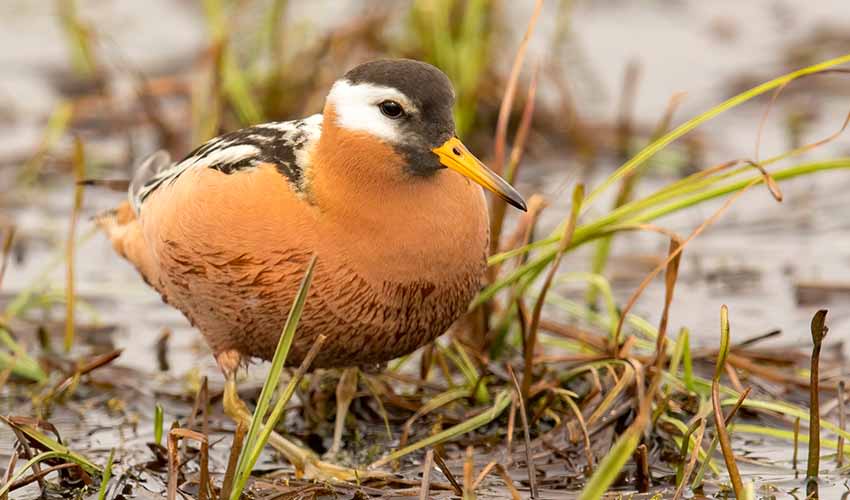
While most sandpipers are defined by their long legs and a life spent wading in the mud, the red phalarope is essentially a seabird in disguise. For most of the year, they live far out in the open ocean, bobbing on the waves like tiny ducks. What makes them physically unique are their feet: instead of long, spindly toes, they have lobed toes—similar to a grebe or a coot—which act like high-performance paddles, making them incredibly strong swimmers in rough Atlantic or Pacific swells.
The most fascinating way they differ from other species is their complete reversal of traditional gender roles. In the world of the red phalarope, the females are the ones with the flashy “tuxedos.” During the summer, the females sport a brilliant, deep brick-red plumage and a striking white eye patch, while the males are much duller and camouflaged. But it goes deeper than just looks: the females are the aggressors who fight over territory and mates. Once the eggs are laid, the female leaves to find another partner, leaving the male to do 100% of the work—from sitting on the eggs to raising the chicks all by himself.
If you ever see a red phalarope in a shallow pool, you’ll witness their most famous “party trick”: the spinning vortex. Instead of pecking at the ground, they swim in tight, rapid circles like a feathered top. This spinning motion creates a mini-whirlpool that sucks tiny crustaceans and larvae up from the bottom and into the center of the vortex, right where the bird can easily pluck them off the surface. It is one of the most specialized and mesmerizing feeding techniques in the entire animal kingdom.
Distribution
 Angola
 Anguilla
 Antarctica
 Antigua & Barbuda
 Argentina
 Australia
 Austria
 Bahamas
 Barbados
 Belgium
 Bermuda
 Bosnia And Herz.
 Botswana
 Brazil
 British Virgin Is.
 Bulgaria
 Cameroon
 Canada
 Cape Verde
 Chile
Chile China
China Colombia
 Costa Rica
 Croatia
 Cuba
Cuba Cyprus
 Czechia
 Côte D’ivoire
 Denmark
 Dominica
 Dominican Republic
 Ecuador
 Egypt
Egypt El Salvador
 Equatorial Guinea
 Faroe Islands
 Finland
 France
 Gambia
 Germany
 Ghana
Ghana Gibraltar
 Greece
 Greenland
Guadeloupe
Greenland
Guadeloupe Guatemala
 Guinea-Bissau
 Guinea
 Honduras
 Hong Kong
 Hungary
 Iceland
 India
India Iran
Iran Iraq
Iraq Ireland
 Israel
 Italy
Italy Japan
Japan Kazakhstan
 Kenya
Kenya Kiribati
 Korea
Korea Kuwait
 Liberia
 Libya
Libya Luxembourg
 Malaysia
 Malta
Martinique
Malta
Martinique Mauritania
 Mexico
 Montenegro
 Morocco
 Mozambique
 Namibia
 Netherlands
 New Zealand
 Nicaragua
 Nigeria
 Norway
 Oman
Oman Panama
 Paraguay
 Peru
Peru Philippines
 Poland
 Portugal
 Puerto Rico
 Romania
 Russia
 Saint Pierre
 Saudi Arabia
 Senegal
 Serbia
 Sierra Leone
 Slovakia
 Slovenia
 South Africa
 Spain
Spain Sri Lanka
Svalbard
Sri Lanka
Svalbard Sweden
 Switzerland
 São Tomé & Príncipe
 Taiwan
 Tajikistan
 Togo
Togo Tunisia
 Turks & Caicos
 UAE
UAE US Virgin Islands
 Ukraine
 United Kingdom
 United States
 Zimbabwe
Anything we've missed?
Help us improve this page by suggesting edits. Glory never dies!
Suggest an editGet to know me
Terrestrial / Aquatic
Altricial / Precocial
Polygamous / Monogamous
Dimorphic (size) / Monomorphic
Active: Diurnal / Nocturnal
Social behavior: Solitary / Pack / Flock
Diet: Carnivore / Herbivore / Omnivore / Piscivorous / Insectivore
Migratory: Yes / No
Domesticated: Yes / No
Dangerous: Yes / No




