


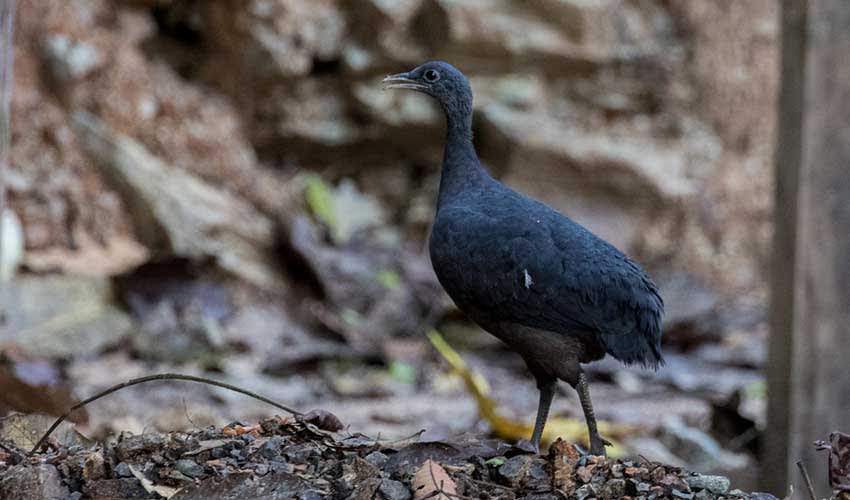
Found mainly in the Amazon Basin and surrounding tropical regions, this large, ground-dwelling bird is rarely seen despite its size. Its plumage is mostly dark charcoal to black, sometimes with subtle brown or gray tones that help it blend perfectly into the shadowy forest floor. The feathers have a soft, velvety texture, which reduces noise as the bird moves through dense undergrowth. With a rounded body, short wings, and a small head perched low on its shoulders, the black tinamou has a quiet, almost secretive presence that suits its hidden lifestyle.
Unlike birds that spend much of their time flying or perching in trees, the black tinamou walks slowly and carefully through leaf litter, using its strong legs to move with surprising grace. Although it can fly, it prefers not to, taking short, explosive flights only when startled. These sudden takeoffs are loud and dramatic, often startling predators and humans alike. Most of the time, however, the bird relies on camouflage and stillness rather than flight for protection.
The black tinamou is also known for its haunting and beautiful call. Its voice is a deep, low whistle that echoes through the rainforest, especially at dawn and dusk. These calls can carry long distances and are often heard long before the bird itself is seen. Each individual has a slightly different call, which helps birds recognize one another in dense forests where visibility is limited. For many people exploring tropical forests, hearing a black tinamou is far more common than actually spotting one.
Like other tinamous, it follows a role reversal compared to many birds. Females may mate with more than one male, laying eggs in different nests. The male then takes full responsibility for incubation and chick care. He guards the eggs carefully and later leads the chicks through the forest, teaching them how to forage and avoid danger.
Distribution
 Bolivia
 Colombia
 Ecuador
 Peru
PeruAnything we've missed?
Help us improve this page by suggesting edits. Glory never dies!
Suggest an editGet to know me
Terrestrial / Aquatic
Altricial / Precocial
Polygamous / Monogamous
Dimorphic (size) / Monomorphic
Active: Diurnal / Nocturnal
Social behavior: Solitary / Pack / Herd
Diet: Carnivore / Herbivore / Omnivore / Piscivorous / Insectivore
Migratory: Yes / No
Domesticated: Yes / No
Dangerous: Yes / No




