


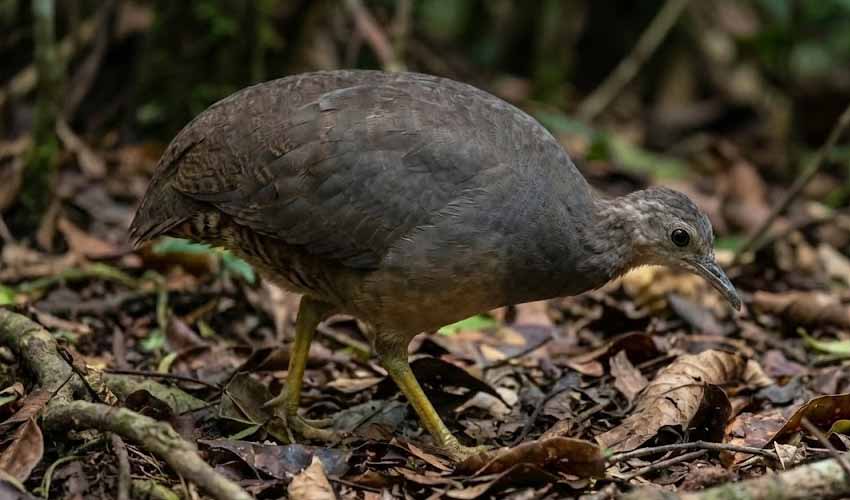
Found mainly in tropical and subtropical forests, this medium-sized, ground-dwelling bird is more often heard than seen. Its plumage is a mix of warm browns, grays, and fine mottled patterns that blend perfectly with leaf litter and forest shadows. These colors provide excellent camouflage, allowing the bird to remain almost invisible as it moves slowly through dense undergrowth. As its name suggests, the yellow-legged tinamou has pale yellow legs, a feature that stands out only when the bird is glimpsed at close range. Its rounded body, short neck, and small head give it a compact, gentle appearance.
Like other tinamous, the yellow-legged tinamou prefers life on the forest floor. It spends most of its time walking quietly rather than flying, using its strong legs to navigate fallen leaves, roots, and low vegetation. Although it can fly, it uses this ability sparingly. When startled, it bursts into the air in a short, powerful flight accompanied by loud wingbeats, often disappearing just as quickly as it appeared. Most of the time, however, it relies on stillness and camouflage to avoid danger. This cautious behavior makes it difficult to observe, even in areas where it is fairly common.
One of the most remarkable features of the yellow-legged tinamou is its voice. Its call is a clear, whistling sound that carries far through the forest, especially in the early morning and late afternoon. These calls help individuals stay in contact across dense habitats where visibility is limited. Each bird has slight variations in its call, allowing others to recognize neighbors or potential mates. For many people exploring South American forests, the distinctive whistle of a tinamou is one of the most memorable sounds of the wild, even if the bird itself remains hidden.
Distribution
 Brazil
 Official estimate
Anything we've missed?
Help us improve this page by suggesting edits. Glory never dies!
Suggest an editGet to know me
Terrestrial / Aquatic
Altricial / Precocial
Polygamous / Monogamous
Dimorphic (size) / Monomorphic
Active: Diurnal / Nocturnal
Social behavior: Solitary / Pack / Herd
Diet: Carnivore / Herbivore / Omnivore / Piscivorous / Insectivore
Migratory: Yes / No
Domesticated: Yes / No
Dangerous: Yes / No




