


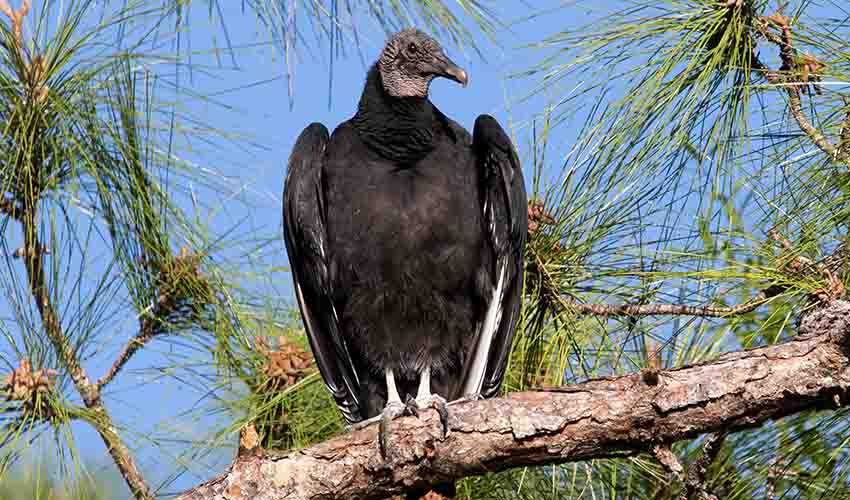
The Black Vulture is the one and only member of its genus, so when you talk about Coragyps, you’re really talking about this single, tough, highly social bird. It ranges from the southeastern United States through Central America and deep into South America, especially common around towns, farms, and open countryside.
At a distance, it looks like a flying chunk of darkness with a short, square tail and broad wings tipped with bright white “hands.” Those white wingtips and the stubby tail are the easiest way to tell it from its neighbor, the turkey vulture, which has a longer tail and mostly dark wings. Up close, the black vulture has a wrinkled gray, featherless head, chocolate-black body, and pale, chalky legs—an outfit that is more practical than pretty for the life it leads.
This bird is a professional clean-up crew, feeding mainly on carrion—dead animals of all sizes from road-killed opossums to cattle remains—and on human waste at landfills and dumps. Unlike the turkey vulture, which uses a super-powered sense of smell to sniff out carcasses, the black vulture mostly relies on eyesight and on watching what other scavengers are doing. It often spots turkey vultures circling something tasty and then dives in, arriving in pushy groups that can crowd out the shyer, solitary feeders.
It’s not just cleaning up old remains, either—on rare occasions it will attack weak or newborn animals, which has brought it into conflict with farmers in some areas. Still, by stripping carcasses quickly, black vultures help stop rotting bodies from piling up and reduce the spread of disease, making them far more helpful to ecosystems than their spooky look suggests.
Distribution
 Antigua & Barbuda
 Argentina
 Bahamas
 Barbados
 Belize
 Bermuda
 Bolivia
 Brazil
 Canada
 Cayman Islands
 Chile
Chile Colombia
 Costa Rica
 Cuba
Cuba Dominica
 Ecuador
 El Salvador
 French Guiana
 Grenada
 Guadeloupe
 Guatemala
 Guyana
 Honduras
 Jamaica
Martinique
Jamaica
Martinique Mexico
 Montserrat
 Nicaragua
 Panama
 Paraguay
 Peru
Peru Puerto Rico
 Saint Lucia
 Saint Vincent
 St. Kitts & Nevis
 Suriname
 Trinidad & Tobago
 United States
 Uruguay
 Venezuela
Anything we've missed?
Help us improve this page by suggesting edits. Glory never dies!
Suggest an editGet to know me
Terrestrial / Aquatic
Altricial / Precocial
Polygamous / Monogamous
Dimorphic (size) / Monomorphic
Active: Diurnal / Nocturnal
Social behavior: Solitary / Pack / Flock
Diet: Carnivore / Herbivore / Omnivore / Piscivorous / Insectivore
Migratory: Yes / No
Domesticated: Yes / No
Dangerous: Yes / No




