


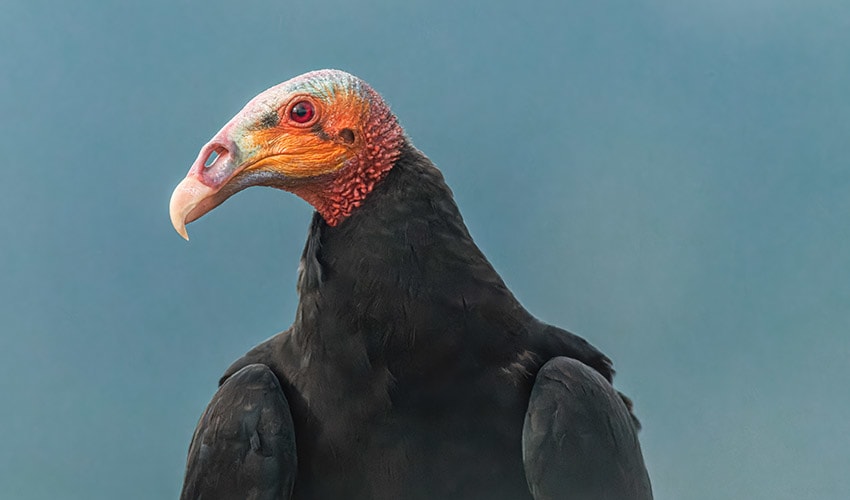
A striking bird of open wetlands and savannas across Mexico, Central America, and much of South America. Instead of circling high like many vultures, it often flies surprisingly low over marshes and flooded fields, rocking gently on its long wings as it searches for food. Up close, it’s impossible to confuse it with anything else: the body is dark and glossy, but the bare head glows in shades of yellow, orange, red, and even a bit of bluish gray, like a tiny sunset on a vulture’s face. Its legs are pale, its eyes are red, and when it perches on a fence post or termite mound, it has a watchful, almost thoughtful look.
One of the coolest things about this species is where and how it lives. The lesser yellow-headed vulture is a wetland specialist, favoring seasonally flooded grasslands, swamps, and mangroves rather than mountains or dense forest. In these soggy places, it soars slowly just above the ground, scanning for dead fish, small animals, and roadkill. It doesn’t usually climb to great heights like some other vultures; staying low helps it spot food in shallow water and on muddy banks. Among New World vultures, it’s also one of the smallest and lightest, which makes its flight look a bit looser and more wobbly than its heavier cousins.
The lesser yellow-headed vulture is famous for something very rare in birds: a powerful sense of smell. Most birds rely on sharp eyesight alone, but this vulture can detect the faint scent of gases released when an animal starts to decay. It uses both sight and smell together, cruising on warm rising air currents while sniffing for food. Its nose is so good that engineers have used its behavior as a tool: they add a smelly gas to buried pipelines, then watch where vultures gather to help locate leaks.
Distribution
 Argentina
 Belize
 Bolivia
 Brazil
 Chile
Chile Colombia
 Costa Rica
 Ecuador
 El Salvador
 French Guiana
 Guatemala
 Guyana
 Honduras
 Mexico
 Nicaragua
 Panama
 Paraguay
 Peru
Peru Suriname
 Uruguay
 Venezuela
Anything we've missed?
Help us improve this page by suggesting edits. Glory never dies!
Suggest an editGet to know me
Terrestrial / Aquatic
Altricial / Precocial
Polygamous / Monogamous
Dimorphic (size) / Monomorphic
Active: Diurnal / Nocturnal
Social behavior: Solitary / Pack / Flock
Diet: Carnivore / Herbivore / Omnivore / Piscivorous / Insectivore
Migratory: Yes / No
Domesticated: Yes / No
Dangerous: Yes / No




