


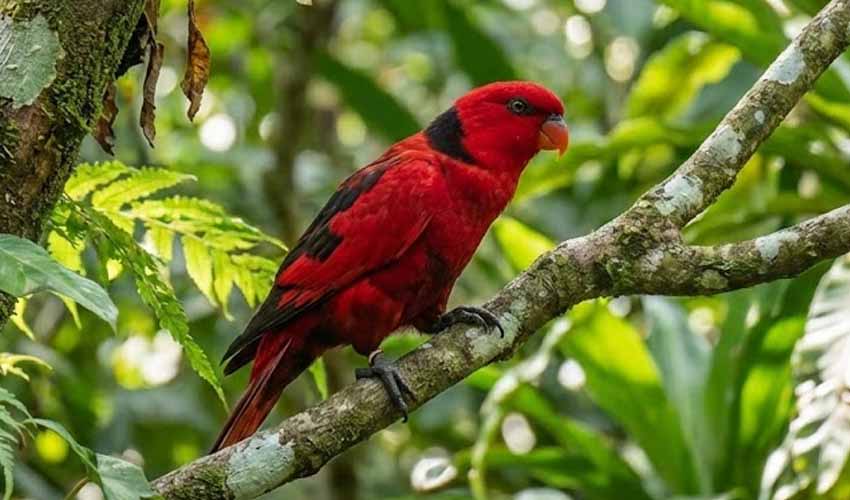
A vibrant and eye-catching parrot native to the forests of New Guinea and nearby islands. It stands out immediately for the strong contrast between its bright red body and deep black wings, a color combination that gives the bird a bold, dramatic appearance. Touches of blue on the belly and hints of darker shades on the tail add even more visual interest. Medium-sized and agile, the black-winged lory is built for fast, direct flight through forest canopies. Its curved beak is well-suited for feeding on soft foods, and its energetic movements reflect a lively and curious personality.
Unlike many parrots that rely heavily on seeds, the black-winged lory has a diet centered on nectar, pollen, and soft fruits. This feeding style sets it apart from most other parrots and plays an important role in its ecosystem. As it moves from flower to flower, it helps pollinate plants, much like a bird version of a bee. Its tongue is specially adapted for this task, allowing it to collect nectar efficiently. These lories are often seen feeding in flowering trees, sometimes gathering in small groups when food is plentiful. Their presence adds bursts of color and sound to the forest as they call and chatter while feeding.
Social behavior is a key part of the black-winged lory’s life. These birds are rarely seen alone and are usually found in pairs or small flocks. They communicate constantly with sharp, high-pitched calls that help them stay in touch as they move through dense foliage. Mated pairs form strong bonds and often feed and rest together. They are active during the day and spend much of their time flying, feeding, and interacting with one another, giving them a reputation as energetic and playful birds.
Distribution
 Indonesia
 Official estimate
Anything we've missed?
Help us improve this page by suggesting edits. Glory never dies!
Suggest an editGet to know me
Terrestrial / Aquatic
Altricial / Precocial
Polygamous / Monogamous
Dimorphic / Monomorphic (size)
Active: Diurnal / Nocturnal
Social behavior: Solitary / Pack / Flock
Diet: Carnivore / Nectarivore / Omnivore / Piscivorous / Insectivore
Migratory: Yes / No
Domesticated: Yes / No
Dangerous: Yes / No




