


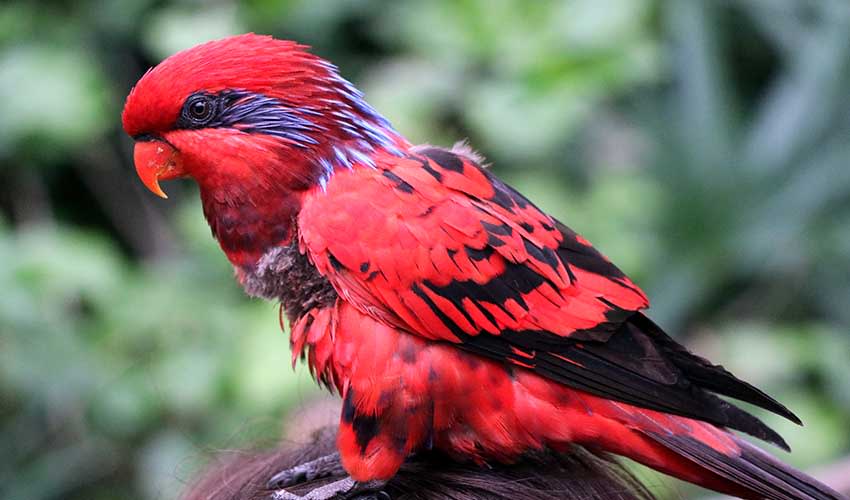
A vivid and energetic parrot native to the tropical forests of New Guinea and nearby islands. It is best known for the bold blue streak that runs across its head and down its neck, a feature that contrasts sharply with its bright red body. This striking combination of red and blue makes the bird instantly recognizable and gives it a lively, almost painted appearance. Touches of black on the wings and hints of green or purple on the back add even more depth to its coloring. Small to medium in size, the blue-streaked lory has a compact body, a short tail, and fast, agile movements that match its energetic nature.
Like most lories, the blue-streaked lory is specially adapted to a nectar-based diet. Instead of relying mainly on seeds, it feeds on nectar, pollen, soft fruits, and blossoms. Its tongue is uniquely shaped to collect nectar efficiently, allowing it to move quickly from flower to flower. This feeding style makes the bird an important pollinator, helping plants reproduce as it travels through the forest. Blue-streaked lories are often seen feeding high in the branches of flowering trees, sometimes gathering in small, noisy groups when food is abundant.
Social behavior is a defining trait of the blue-streaked lory. These birds are rarely alone and are usually found in pairs or small flocks. They communicate constantly using sharp, high-pitched calls that help them stay connected while flying through dense forest canopies. Their flight is fast and direct, often appearing as flashes of red and blue darting between trees. Mated pairs form strong bonds and often feed and rest close together, showing clear signs of cooperation and attachment.
Distribution
 Indonesia
 Official estimate
Anything we've missed?
Help us improve this page by suggesting edits. Glory never dies!
Suggest an editGet to know me
Terrestrial / Aquatic
Altricial / Precocial
Polygamous / Monogamous
Dimorphic / Monomorphic (size)
Active: Diurnal / Nocturnal
Social behavior: Solitary / Pack / Flock
Diet: Carnivore / Frugivore / Omnivore / Piscivorous / Insectivore
Migratory: Yes / No
Domesticated: Yes / No
Dangerous: Yes / No




