


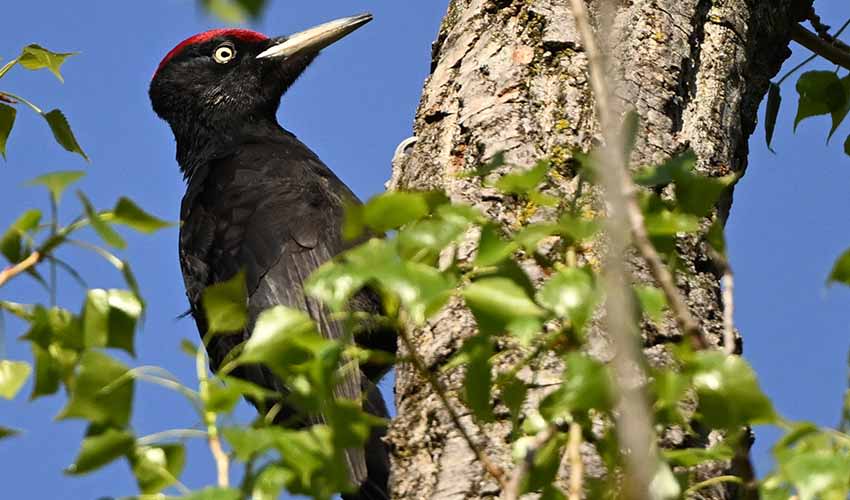
The heavyweight of many European and northern Asian forests—a large, crow-sized woodpecker that looks like a flying piece of midnight with a flash of red on its head. Most of its body is glossy black, from bill to tail, which makes it stand out strongly against pale trunks and snowy winter woods. The red crown is the signature detail: males usually show a fuller red “cap,” while females typically have a smaller red patch toward the back of the head. Its bill is long, pale, and chisel-like, and its eyes have a sharp, focused look that matches its intense, purposeful behavior.
What makes the black woodpecker especially distinct is its power and the scale of its woodworking. It doesn’t just tap politely—it can hammer so forcefully that the sound carries far through the forest, like someone striking a wooden wall. Instead of picking at small cracks, it often excavates deep into trunks to reach insects hiding in the wood, especially ants and beetle larvae. You might notice fresh, pale wood chips scattered at the base of a tree—one of the easiest signs that a black woodpecker has been working nearby. It also has a bold, ringing voice that can cut through quiet woods, and it tends to announce itself more than many other woodpeckers, especially during breeding season. Even its posture looks confident: it climbs with quick, sure steps and pauses often, as if listening for movement under bark before striking.
The black woodpecker stands out from other woodpeckers in its neighborhood not only by size, but by what it creates. The nesting holes it carves are large and deep, and they often become valuable real estate for other animals once the woodpecker moves on. Owls, ducks that nest in tree cavities, and other birds that can’t carve their own homes may use these openings later, which means one black woodpecker can shape the whole forest community without meaning to.
Distribution
 Albania
 Andorra
 Armenia
 Austria
 Azerbaijan
 Belarus
 Belgium
 Bosnia And Herz.
 Bulgaria
 China
China Croatia
 Czechia
 Denmark
 Estonia
 Finland
 France
 Georgia
 Germany
 Greece
 Hungary
 Iran
Iran Italy
Italy Japan
Japan Kazakhstan
 Korea
Korea Latvia
 Liechtenstein
 Lithuania
 Luxembourg
 Moldova
 Mongolia
 Montenegro
 Netherlands
 North Korea
 North Macedonia
 Norway
 Poland
 Portugal
 Romania
 Russia
 Serbia
 Slovakia
 Slovenia
 Spain
Spain Sweden
 Switzerland
 Turkey
 Ukraine
Anything we've missed?
Help us improve this page by suggesting edits. Glory never dies!
Suggest an editGet to know me
Terrestrial / Aquatic
Altricial / Precocial
Polygamous / Monogamous
Dimorphic (size) / Monomorphic
Active: Diurnal / Nocturnal
Social behavior: Solitary / Pack / Herd
Diet: Carnivore / Herbivore / Omnivore / Piscivorous / Insectivore
Migratory: Yes / No
Domesticated: Yes / No
Dangerous: Yes / No




