


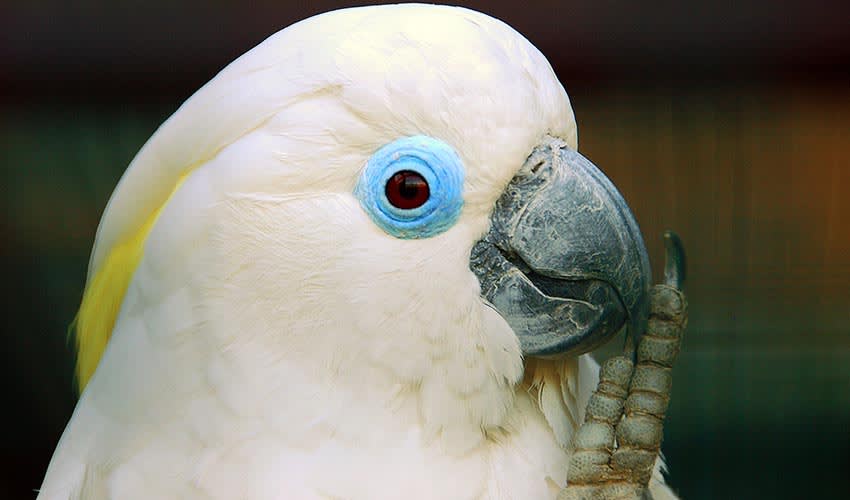
A striking and powerful parrot native to the lowland forests of New Guinea and nearby islands. It is best known for its intense blue eye rings, which stand out vividly against its mostly black feathers and pale bill. This bold eye color gives the bird a piercing, expressive look that immediately captures attention. Large and heavy-bodied, the blue-eyed cockatoo has broad wings, a strong, curved beak, and a short crest that it can raise when excited or alert. When flying, its wingbeats are deep and steady, and its presence in the forest feels commanding and unmistakable.
This cockatoo is closely tied to dense tropical forests, where it spends most of its life high in the canopy. It feeds on a varied diet of fruits, seeds, nuts, and berries, using its powerful beak to crack open tough shells and husks. The blue-eyed cockatoo is highly skilled at manipulating food, often holding it with one foot while carefully biting and rotating it. These feeding habits play a role in seed dispersal, helping maintain healthy forest ecosystems. Although it can move across wide areas in search of food, it depends heavily on large, mature trees that provide both nourishment and nesting sites.
Social behavior is an important part of the blue-eyed cockatoo’s life. These birds are often seen in pairs or small family groups, though larger gatherings may form where food is abundant. They communicate using loud calls that travel far through the forest, allowing individuals to stay in contact even when hidden by dense foliage. Mated pairs form strong, long-term bonds and often remain together for many years. During the breeding season, they nest in natural cavities high in large trees. Both parents take part in raising the chick, feeding and protecting it until it is ready to leave the nest.
Distribution
 Papua New Guinea
 Official estimate
Anything we've missed?
Help us improve this page by suggesting edits. Glory never dies!
Suggest an editGet to know me
Terrestrial / Aquatic
Altricial / Precocial
Polygamous / Monogamous
Dimorphic (size) / Monomorphic
Active: Diurnal / Nocturnal
Social behavior: Solitary / Pack / Flock
Diet: Carnivore / Herbivore / Omnivore / Piscivorous / Insectivore
Migratory: Yes / No
Domesticated: Yes / No
Dangerous: Yes / No




