


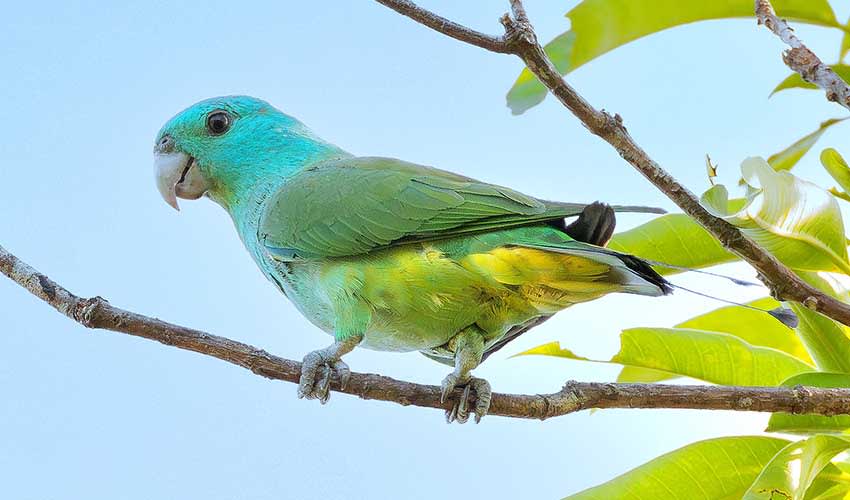
A striking and elegant parrot found in the forests of the Philippines, where it lives among tall trees and dense vegetation. It is best known for its unique tail feathers, which end in rounded, paddle-like tips called “rackets.” These unusual feathers make the bird instantly recognizable, especially in flight. The parrot’s head is a rich blue that contrasts beautifully with its green body, giving it a bright, eye-catching appearance in the forest canopy.
One of the most distinctive features of the blue-headed racket-tail is its tail. The long central tail feathers extend well beyond the rest and end in flat, rounded tips. When the bird flies, these racket-shaped feathers sway and twist, creating a graceful and almost decorative effect. Scientists believe these feathers play a role in courtship, helping individuals attract mates. Few parrots in the world have such specialized tail feathers, making this species truly unique among its relatives.
The blue-headed racket-tail spends most of its time high in the forest canopy, where it feeds on fruits, seeds, and nuts. It is well adapted to life in tall trees, using its strong beak to crack open tough food and its agile feet to grip branches securely. The bird is usually seen in pairs or small groups, quietly moving through the trees. Its calls are soft and nasal compared to those of louder parrots, helping it stay less noticeable in dense forest environments.
Breeding behavior adds another layer of interest to this parrot’s life. The blue-headed racket-tail nests in tree cavities, choosing holes that offer safety from predators. During the breeding season, pairs become more territorial, defending their nesting area from other birds. The female lays a small number of eggs, and both parents care for the chicks. The young birds grow slowly, remaining dependent on their parents for an extended period as they learn to feed and move confidently through the forest.
Distribution
 Philippines
 Official estimate
Anything we've missed?
Help us improve this page by suggesting edits. Glory never dies!
Suggest an editGet to know me
Terrestrial / Aquatic
Altricial / Precocial
Polygamous / Monogamous
Dimorphic (size) / Monomorphic
Active: Diurnal / Nocturnal
Social behavior: Solitary / Pack / Herd
Diet: Carnivore / Herbivore / Omnivore / Piscivorous / Insectivore
Migratory: Yes / No
Domesticated: Yes / No
Dangerous: Yes / No




