


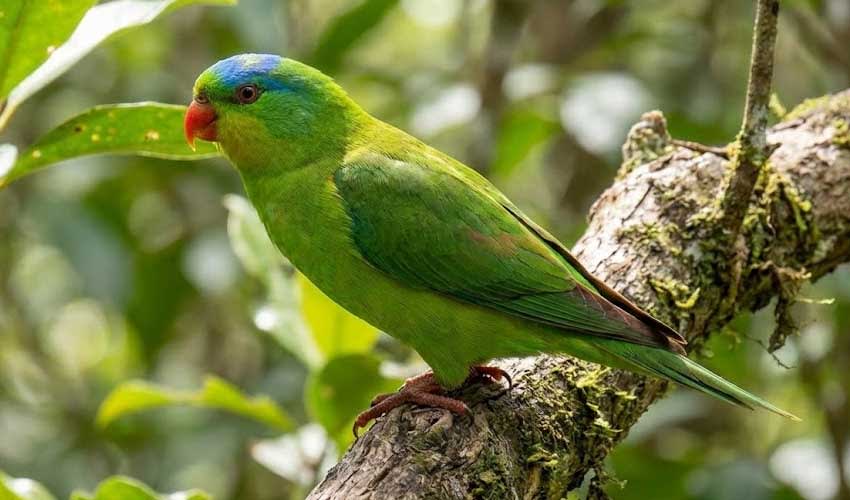
Though now believed to be extinct, it remains one of the most intriguing birds of the region because of its beauty, rarity, and mystery. This lorikeet had a compact body, a short tail, and bright green feathers that covered most of its body, helping it blend into the lush island forests. What made it especially eye-catching were the flashes of red and yellow on its face and chest, giving it a lively, almost painted look. Its curved orange beak and alert eyes added to its cheerful appearance, making it stand out among other small parrots.
Like other lorikeets, it had a brush-like tongue designed for sipping nectar and pollen from flowers. This set it apart from many parrots that rely mainly on seeds and nuts. Its diet likely included nectar, soft fruits, and blossoms from native trees, which tied its survival closely to healthy forests. Compared to other lorikeets in nearby regions, it was smaller and more delicately built, suggesting it was adapted to moving quickly through dense vegetation rather than flying long distances.
What truly distinguished the New Caledonian lorikeet from other members of the lorikeet group was its extremely limited range. It lived only on New Caledonia, an island known for its unique plants and animals found nowhere else on Earth. This isolation allowed the bird to develop its own traits, but it also made it vulnerable. While many lorikeets are widespread and adaptable, this species depended heavily on native forests that were gradually reduced by human settlement. Introduced predators and habitat loss likely played major roles in its disappearance, making it one of the more fragile members of its family.
Distribution
 New Caledonia
Anything we've missed?
Help us improve this page by suggesting edits. Glory never dies!
Suggest an editGet to know me
Terrestrial / Aquatic
Altricial / Precocial
Polygamous / Monogamous
Dimorphic (size) / Monomorphic
Active: Diurnal / Nocturnal
Social behavior: Solitary / Pack / Herd
Diet: Carnivore / Granivore / Omnivore / Piscivorous / Insectivore
Migratory: Yes / No
Domesticated: Yes / No
Dangerous: Yes / No




