


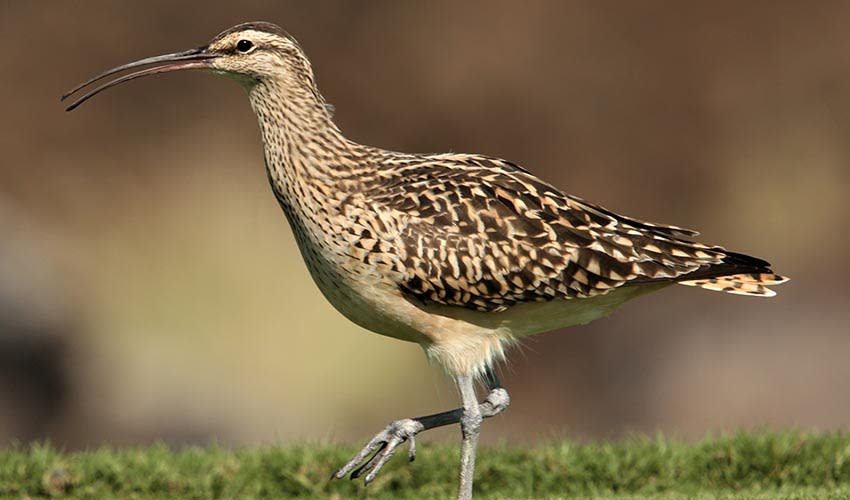
At first glance, it looks a lot like a whimbrel: a medium-sized shorebird with a long, down-curved bill and warm brown, heavily patterned feathers. Look closer, though, and you’ll spot its trademarks: a buffy, unmarked belly, a rusty tail, and the short, stiff “bristles” on the thighs that give the species its name. It breeds only in western Alaska, on low, rolling tundra dotted with dwarf willows, sedges, and wetlands. In summer, pairs defend wide territories, and the male performs display flights over the tundra, calling as he circles and glides back to earth.
Once the short Arctic summer is over, this curlew’s life turns dramatic. Adults leave the chicks on the breeding grounds and head south across the open Pacific, flying thousands of kilometres non-stop to remote tropical islands. Many stage through or winter in the Northwestern Hawaiian Islands; others continue on to atolls and islands scattered across Micronesia, Polynesia, and Fiji. These journeys can exceed 6,000 kilometres (3,728 miles) without a break, making the Bristle-thighed curlew one of the great long-distance fliers among shorebirds. Young birds follow later, navigating to the same tiny specks of land in the middle of the ocean, guided by instincts and cues we still don’t fully understand.
Life on the wintering grounds is very different from life in Alaska. On tropical islands, Bristle-thighed curlews roam beaches, coral rubble, grassy clearings, and even village edges. Their diet is impressively varied: they pick crabs and other invertebrates along the shore, probe for insects in leaf litter, and feast on berries and flowers inland. They’re also one of the few shorebirds known to use tools—they have been seen picking up small rocks or shells and smashing other birds’ eggs with them to get at the contents. During part of their stay, they molt all their main flight feathers at once and become temporarily flightless, skulking in vegetation or on quiet islets while new feathers grow in.
Distribution
 American Samoa
 Chile
Chile Cook Islands
 Fiji
Fiji French Polynesia
 Guam
Guam Indonesia
 Japan
Japan Kiribati
 Marshall Islands
 Micronesia
 Nauru
Nauru New Zealand
 Niue
Niue Nort. Mariana Is.
 Papua New Guinea
 Philippines
 Pitcairn
 Samoa
Samoa Solomon Islands
 Tokelau
 Tonga
Tonga Tuvalu
 US Minor Is.
 United States
 Wallis & Futuna
Anything we've missed?
Help us improve this page by suggesting edits. Glory never dies!
Suggest an editGet to know me
Terrestrial / Aquatic
Altricial / Precocial
Polygamous / Monogamous
Dimorphic (size) / Monomorphic
Active: Diurnal / Nocturnal
Social behavior: Solitary / Pack / Flock
Diet: Carnivore / Herbivore / Omnivore / Piscivorous / Insectivore
Migratory: Yes / No
Domesticated: Yes / No
Dangerous: Yes / No




