


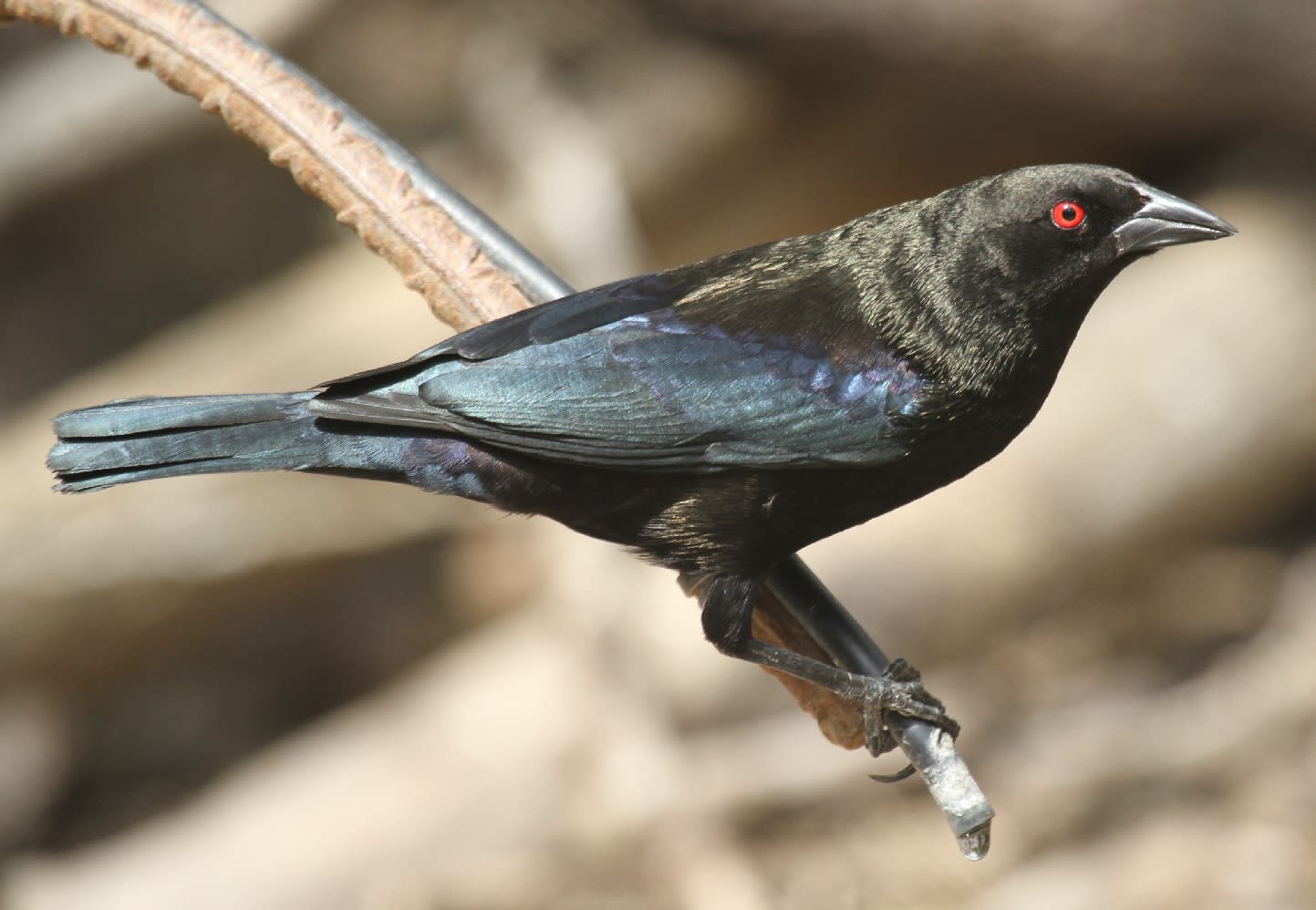
Found from the southern United States through Mexico and Central America, this bird prefers open landscapes — pastures, agricultural fields, grasslands, and suburban edges — places where it can easily spot other birds raising young. Adult males are striking, dressed in shimmering bronze-black feathers that gleam in sunlight, paired with piercing red eyes that seem to stare right through you. Females are more subtle in brown-gray tones, but both sexes share an unmistakable attitude: confident, alert, and always watching for opportunity.
Like other cowbirds, the bvronzed cowbird is a brood parasite, meaning it lays eggs in the nests of other birds and leaves the parenting to foster hosts. Instead of weaving their own nests, females roam territories searching for nests of doves, thrashers, orioles, flycatchers, and other species. Once they find a target nest, they slip in, deposit one of their eggs, and depart — leaving the unsuspecting host to raise a chick that isn’t theirs. Their eggs hatch quickly, and the chicks grow fast, often out-competing their nestmates for food and attention. While this strategy might sound ruthless, it’s a remarkable evolutionary gambit that has allowed cowbirds to flourish in changing landscapes. Some host species have even developed counter defenses, recognizing cowbird eggs or building new nests over parasitized ones — setting the stage for a fascinating evolutionary arms race.
Bronzed cowbirds forage on the ground in flocks, walking with a proud swagger as they peck at insects, seeds, and grains. They are especially fond of insects kicked up by grazing livestock — a behavior rooted in their ancestral ties to massive bison herds on the plains. Males are known for dramatic displays in breeding season: puffing their feathers, stretching their wings, and lifting into short hovering flights around females. Their song is a combination of soft rattles and whistles, not the most melodic in the bird world, but delivered with plenty of confidence.
Distribution
 Belize
 Costa Rica
 El Salvador
 Guatemala
 Honduras
 Mexico
 Nicaragua
 Panama
 United States
Anything we've missed?
Help us improve this page by suggesting edits. Glory never dies!
Suggest an editGet to know me
Terrestrial / Aquatic
Altricial / Precocial
Polygamous / Monogamous
Dimorphic (size) / Monomorphic
Active: Diurnal / Nocturnal
Social behavior: Solitary / Pack / Flock
Diet: Carnivore / Herbivore / Omnivore / Piscivorous / Insectivore
Migratory: Yes / No
Domesticated: Yes / No
Dangerous: Yes / No




