


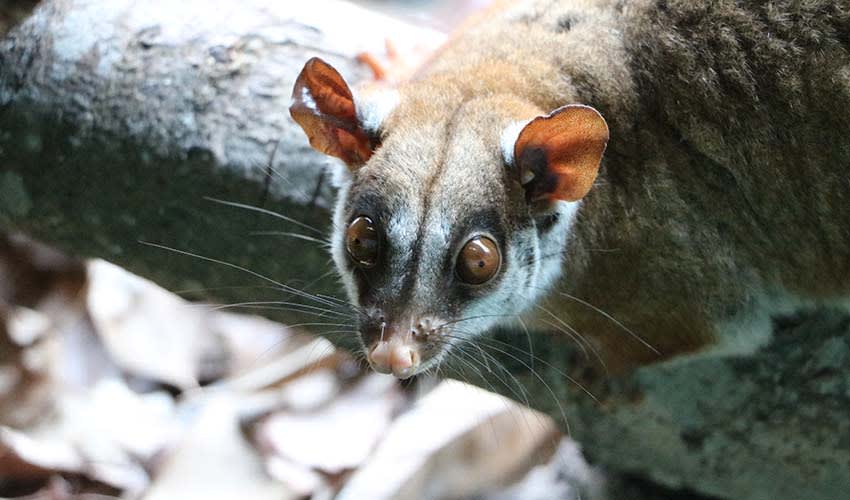
A tiny, tree-dwelling mix between a plush toy and a night gremlin from South America’s forests. It’s a small, softly built marsupial with thick, woolly fur that ranges from warm brown to reddish-brown on the back and limbs, and a yellowish to orange belly that looks almost like it’s wearing a glowing vest. Its ears are hairless and brown with a hint of pink at the edges—hence the name “brown-eared”—and its face carries faint orange eye-rings and a dark stripe running from the nose up between the eyes to the ears. The tail is one of its coolest features: the base and upper half are furry, but the last third is bare, pale, and lightly spotted, with a strong prehensile grip so it can hang on to branches like a fifth limb as it climbs and feeds.
This little opossum is a creature of the night and the treetops. It’s mostly nocturnal and arboreal, spending its days tucked away in leafy nests or tree cavities and heading out after dark to prowl along branches. Because it’s small, quiet and active at night, people can live near it and rarely notice it is there; most sightings come from spotlighting, camera traps or chance encounters when it freezes on a branch, huge dark eyes reflecting the light.
Diet-wise, the brown-eared woolly opossum is a flexible foodie, but with a strong sweet tooth. It eats a lot of fruit from a variety of forest trees and vines, but will also take nectar, insects, spiders and the occasional small vertebrate if it can catch one. Its gut is well adapted for a frugivorous lifestyle, and by swallowing fruits whole and dropping the seeds in its droppings, it helps spread many plant species around the forest. Its visits to night-blooming flowers, where it licks nectar and brushes against pollen, may also make it a secret pollinator for some trees—an unassuming, furry “bee” of the canopy.
Distribution
 Argentina
 Bolivia
 Brazil
 Colombia
 Ecuador
 Guyana
 Paraguay
 Peru
Peru Venezuela
Anything we've missed?
Help us improve this page by suggesting edits. Glory never dies!
Suggest an editGet to know me
Terrestrial / Aquatic
Altricial / Precocial
Polygamous / Monogamous
Dimorphic (size) / Monomorphic
Active: Diurnal / Nocturnal
Social behavior: Solitary / Pack / Herd
Diet: Carnivore / Frugivore / Omnivore / Piscivorous / Insectivore
Migratory: Yes / No
Domesticated: Yes / No
Dangerous: Yes / No




