


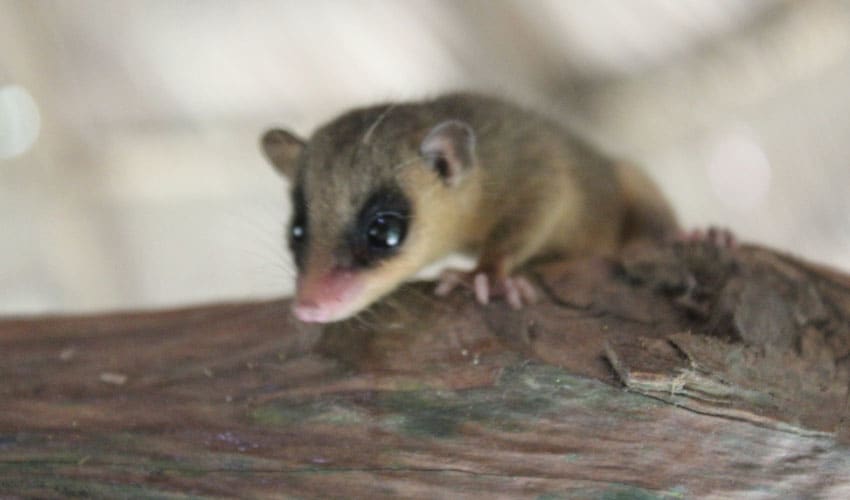
A small, night-active marsupial that looks like it was made for slipping through forest shadows. It has a narrow, lightweight body, a long pointed snout, and large dark eyes that shine in low light, giving it a quietly curious expression. Its most obvious feature is the contrast in its coat: darker fur along the back and sides, and a noticeably pale, clean-looking belly that can make it seem like it’s wearing a light undershirt. The ears are thin and alert, and the tail is long, flexible, and mostly bare—less a fluffy decoration and more a balancing tool. With nimble hands and feet that grip well, it can climb along shrubs, vines, and low branches with the careful confidence of an animal that knows the canopy is safer than the ground.
When most people hear “opossum,” they picture a larger, tougher animal that scavenges broadly on the ground. Slender opossums are different: smaller, lighter, and more tuned to life in the understory and low trees, where stealth and balance matter more than size. The pale belly is a useful clue in a group of animals that can look similar at first glance—small gray-brown bodies, pointed snouts, quick movements. In dim forest light, that lighter underside can stand out when the animal climbs, stretches, or turns, giving a quick “flash” that can help someone recognize it.
Its daily routine is mostly nocturnal, so the white-bellied slender opossum does most of its exploring after sunset. It often hunts and forages with a careful rhythm: move a little, pause to sniff, pause to listen, then move again. Insects and other small prey can be important food, and they may also eat fruit or other forest snacks when it finds them—being flexible is a key advantage in environments where food changes with season and weather.
Distribution
 Bolivia
 Brazil
 Colombia
 Ecuador
 Peru
PeruAnything we've missed?
Help us improve this page by suggesting edits. Glory never dies!
Suggest an editGet to know me
Terrestrial / Aquatic
Altricial / Precocial
Polygamous / Monogamous
Dimorphic (size) / Monomorphic
Active: Diurnal / Nocturnal
Social behavior: Solitary / Pack / Herd
Diet: Carnivore / Herbivore / Omnivore / Piscivorous / Insectivore
Migratory: Yes / No
Domesticated: Yes / No
Dangerous: Yes / No




