


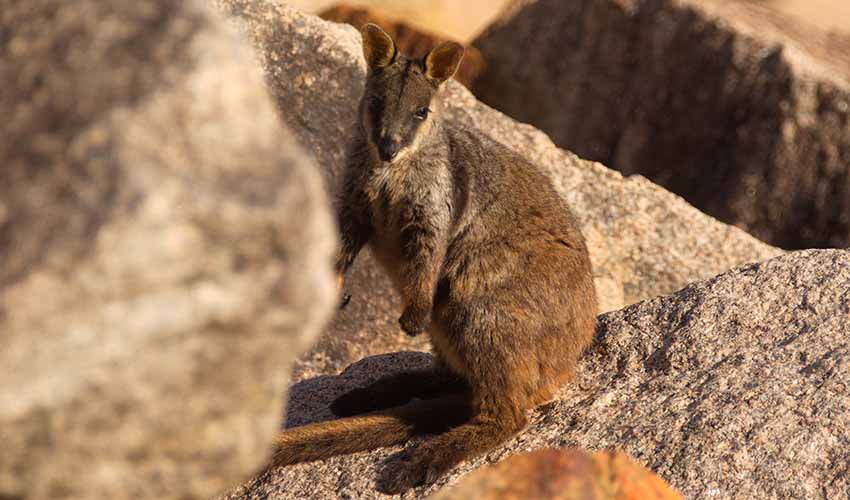
Instead of living out in open grassland, it prefers a world of stone: broken ridges, rocky gullies, and cliff lines where crevices double as bedrooms and escape routes. Its body is built for that terrain, with powerful hind legs for springy leaps, strong forearms for steadying itself on uneven surfaces, and a long tail that acts like a balancing pole. The feature that gives it its name is especially noticeable: the tail is thick and bushy toward the end, like a bottlebrush, which helps it keep balance when it lands on slanted rock or makes a sharp mid-hop turn.
What sets the brush-tailed rock-wallaby apart from many other rock-wallabies is its broad recognition and its “classic” look—often gray-brown with a paler belly, plus a dark stripe along the back and that unmistakable brushy tail tip. It’s found in scattered rocky habitats along eastern Australia, and because it has to live in specific rocky refuges rather than continuous open country, its populations can be naturally patchy—like separate neighborhoods in a long chain of cliffs. Compared with some rock-wallabies that are tied to very small regions, the brush-tailed rock-wallaby has historically been better known, but that doesn’t make its life easy.
A brush-tailed rock-wallaby’s daily routine is a careful dance between hunger, heat, and safety. During the day, it often rests in shaded caves, cracks, and overhangs where the rock stays cooler than the sunlit slopes outside. When the light softens—late afternoon into night—it emerges to feed on grasses, herbs, and leaves from shrubs, usually staying close to the rocks so it can retreat fast. If danger appears, it doesn’t need to win a sprint across flat ground; it needs to reach the boulder maze. Once among rocks, it can hop upward and sideways with impressive accuracy, using its tail to counterbalance quick pivots and sudden stops.
Distribution
 Australia
 Official estimate
Anything we've missed?
Help us improve this page by suggesting edits. Glory never dies!
Suggest an editGet to know me
Terrestrial / Aquatic
Altricial / Precocial
Polygamous / Monogamous
Dimorphic (size) / Monomorphic
Active: Diurnal / Nocturnal
Social behavior: Solitary / Pack / Herd
Diet: Carnivore / Herbivore / Omnivore / Piscivorous / Insectivore
Migratory: Yes / No
Domesticated: Yes / No
Dangerous: Yes / No




