


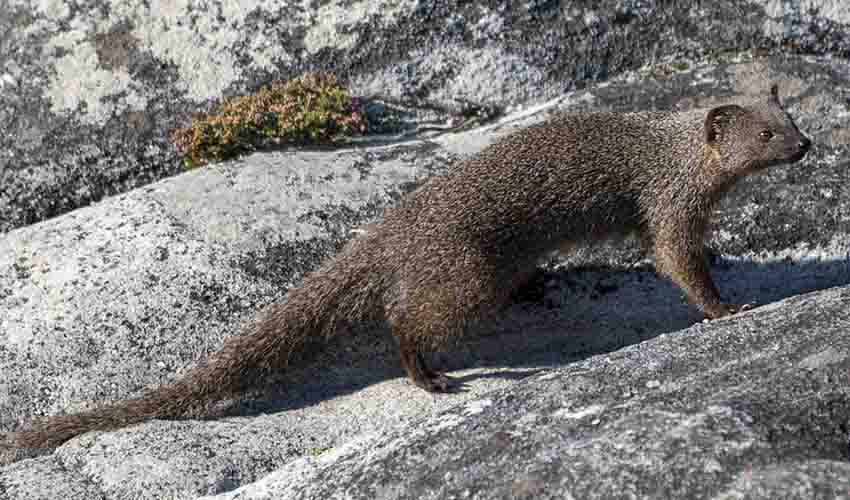
A sleek little predator from southern Africa that looks a bit like a stretched-out cat in a smoke-gray coat. It has a long, low body, short legs, and a furry tail that’s almost as long as the rest of it. The fur is usually a mix of gray and black hairs that give it a salt-and-pepper look, with a slightly darker tail tip and a lighter underside. Up close, you can see that it isn’t just “plain gray” at all—there’s a fine speckling that helps it blend into dry grass, scrub, and stony ground. The head is neat and pointed, with small, rounded ears and sharp, curious eyes that make it look permanently alert. It’s not a big animal—more “large ferret” than “small dog”—but it’s all muscle and quick reflexes.
What makes the Cape gray mongoose especially interesting is how adaptable and bold it is. It lives in open scrub, fynbos, farmlands, and even around villages and towns, trotting along fence lines, ditches, and rocky edges as if they were its personal highways. It’s mostly active by day, especially in the cooler morning and late afternoon, and is usually seen alone or in pairs, trotting with its tail held straight out behind it.
Its diet is classic mongoose “grab whatever you can” style: beetles, grasshoppers, spiders, scorpions, lizards, snakes, rodents, birds, eggs, and sometimes fruit or carrion. It will nose into cracks, flip small stones, and probe bushes for movement, pouncing with quick, cat-like strikes. On farms, it quietly helps control rats and mice, though it will also raid chicken runs if given an easy chance, which doesn’t always make it popular.
The Cape gray mongoose doesn’t usually dig deep burrows of its own. Instead, it takes advantage of what’s already there: old termite mounds, rock crevices, hollow logs, or abandoned burrows dug by other animals like aardvarks or porcupines. These ready-made shelters become its sleeping spots and safe hideouts during the night or the hottest part of the day.
Distribution
 Lesotho
 Namibia
 South Africa
Anything we've missed?
Help us improve this page by suggesting edits. Glory never dies!
Suggest an editGet to know me
Terrestrial / Aquatic
Altricial / Precocial
Polygamous / Monogamous
Dimorphic (size) / Monomorphic
Active: Diurnal / Nocturnal
Social behavior: Solitary / Pack / Herd
Diet: Carnivore / Herbivore / Omnivore / Piscivorous / Insectivore
Migratory: Yes / No
Domesticated: Yes / No
Dangerous: Yes / No




