


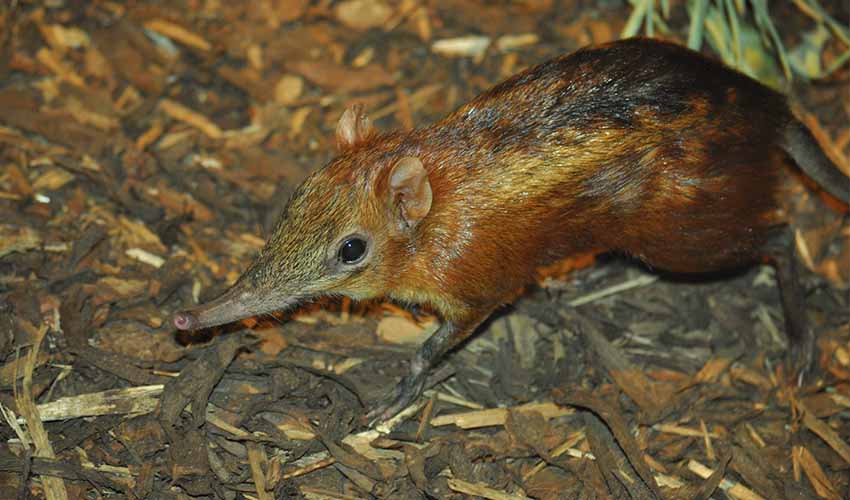
Looks like someone shrank an antelope, added a very fancy coat pattern, and then gave it a tiny trunk. It’s one of the larger sengis, with a body about the length of your hand and forearm and a tail almost as long again. Instead of plain brown, its fur is covered in bold patches of black, brown, and yellowish or orange, forming a checkered or patchwork pattern across the back and sides. Up close, you see a long, flexible nose, big dark eyes, and slim legs built for sprinting. From above, it almost looks like a miniature deer; from the front, that twitchy, tube-like nose makes the “elephant” part of its name very obvious.
Chequered sengis live in forests and dense woodland in parts of central and eastern Africa, usually where there’s plenty of leaf litter and fallen branches on the ground. They are ground specialists, not tree climbers. Instead of wandering randomly, each animal builds a network of narrow “runways” through the leaves—little trails that loop between shelter spots, feeding areas, and a nest.
During the day, they rest in a hidden nest made of leaves tucked under roots, logs, or dense shrubs. In the cooler parts of the day, they come bursting out onto their trails, noses sweeping side to side like tiny vacuum cleaners. Most of their food is small creatures: ants, termites, beetles, and other invertebrates they find by smell and quick pecks of the nose and tongue. They’ll also snap up worms and other soft-bodied snacks when they find them.
Distribution
 Central Af. Rep.
 DR Congo (Kinshasa)
 Malawi
 Mozambique
 Tanzania
 Uganda
 Zambia
Anything we've missed?
Help us improve this page by suggesting edits. Glory never dies!
Suggest an editGet to know me
Terrestrial / Aquatic
Altricial / Precocial
Polygamous / Monogamous
Dimorphic / Monomorphic
Active: Diurnal / Nocturnal
Social behavior: Solitary / Pack / Herd
Diet: Carnivore / Herbivore / Omnivore / Piscivorous / Insectivore
Migratory: Yes / No
Domesticated: Yes / No
Dangerous: Yes / No




