


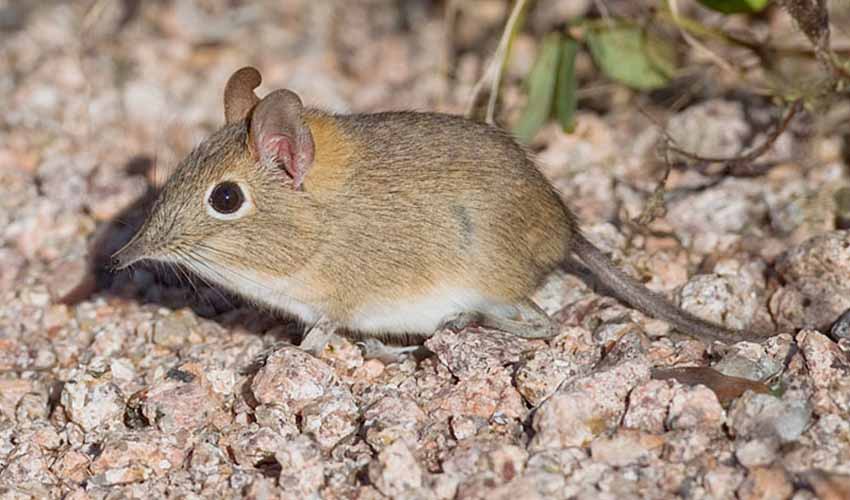
A tiny African mammal that looks like it borrowed parts from several animals and somehow made them work perfectly. It has a long, flexible snout that wiggles and probes like a mini trunk, big alert eyes, and long, springy legs that make it look ready to bolt at any second. Its coat is usually sandy to brownish-gray, which blends neatly with dry soil and scrubby vegetation, and its tail is slim and practical rather than fluffy.
While some sengis prefer thick forest or wetter habitats, this one is a specialist of arid shrubland, savanna edges, and desert-like places with loose soil—exactly the kind of ground that’s easy to dig into and easy to sprint across. Another standout trait is its social setup: bushveld elephant shrews often live as monogamous pairs that hold a territory, but they aren’t “clingy couples.” They may share a home range while still acting fairly independent, like roommates who cooperate mainly because it works. This mix—pair living with plenty of personal space—helps separate them from many small mammals that either live in large groups or remain strictly solitary.
One of the most fun is their habit of keeping runways clear through the brush. Think of them as tiny landscapers: they keep little pathways free of obstacles so they can sprint through their territory without tripping over twigs or getting snagged by plants. These routes double as escape lanes—if a predator shows up, the sengi can rocket down a pre-cleared track like it’s using a private highway. Food-wise, they’re mainly insect hunters, sniffing out ants, termites, beetles, spiders, and other small prey, then snapping them up with quick movements.
Distribution
 Angola
 Botswana
 Namibia
 South Africa
Anything we've missed?
Help us improve this page by suggesting edits. Glory never dies!
Suggest an editGet to know me
Terrestrial / Aquatic
Altricial / Precocial
Polygamous / Monogamous
Dimorphic (size) / Monomorphic
Active: Diurnal / Nocturnal
Social behavior: Solitary / Pack / Herd
Diet: Carnivore / Herbivore / Omnivore / Piscivorous / Insectivore
Migratory: Yes / No
Domesticated: Yes / No
Dangerous: Yes / No




