


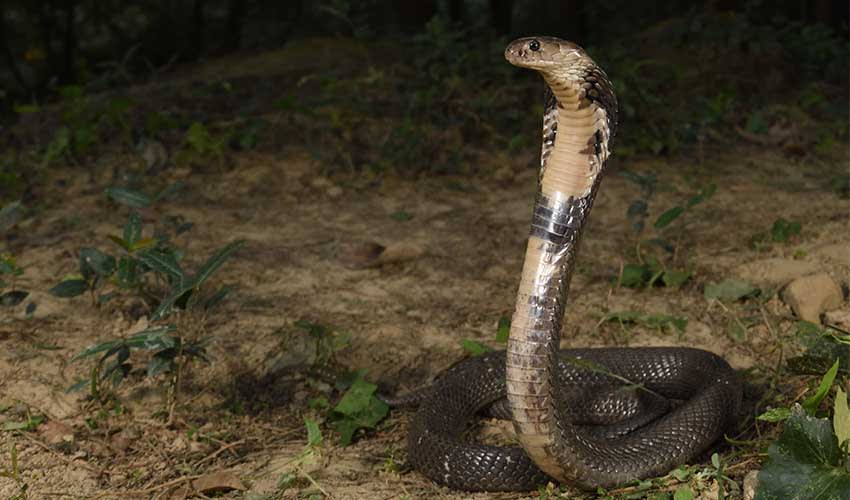
One of the most striking and well-known snakes in East Asia—a sleek, intelligent predator that perfectly embodies both grace and danger. Native to southern China, Taiwan, northern Vietnam, Laos, and parts of Hong Kong, this cobra is a symbol of power and respect in local culture and an important species in its natural ecosystems.
Its body is glossy and smooth, colored in shades of dark brown, olive, or black, often with lighter bands or speckles running along the sides. The underside is usually lighter, sometimes marked with black and white bands near the throat. The most distinctive feature, however, appears when it feels threatened: the cobra raises the front part of its body and spreads its impressive hood, revealing a dramatic spectacle-shaped marking—a pair of light oval spots resembling eyes.
The Chinese cobra is highly adaptable, thriving in a variety of habitats, including woodlands, grasslands, farmlands, and even the edges of cities. It prefers areas near water, where prey is abundant. Its diet includes frogs, toads, small mammals, lizards, and occasionally birds. A skilled hunter, the Chinese cobra uses both stealth and precision, striking quickly and injecting potent neurotoxic venom that immobilizes its prey within seconds. This same venom, though dangerous to humans, is rarely deployed unless the snake feels cornered or provoked. In fact, this cobra is generally shy and prefers to retreat rather than attack, making most encounters avoidable with caution and respect.
Beyond its fierce reputation, the Chinese cobra plays a vital ecological role by controlling populations of rodents and amphibians, helping maintain balance in agricultural areas. However, it faces growing threats from habitat destruction, road mortality, and illegal collection for traditional medicine and snake trade.
Distribution
 China
China Hong Kong
 Laos
Laos Macao
Macao Taiwan
 Vietnam
Anything we've missed?
Help us improve this page by suggesting edits. Glory never dies!
Suggest an editGet to know me
Terrestrial / Aquatic
Altricial / Precocial
Polygamous / Monogamous
Dimorphic (size) / Monomorphic
Active: Diurnal / Nocturnal
Social behavior: Solitary / Pack / Herd
Diet: Carnivore / Herbivore / Omnivore / Piscivorous / Insectivore
Migratory: Yes / No
Domesticated: Yes / No
Dangerous: Yes / No




