


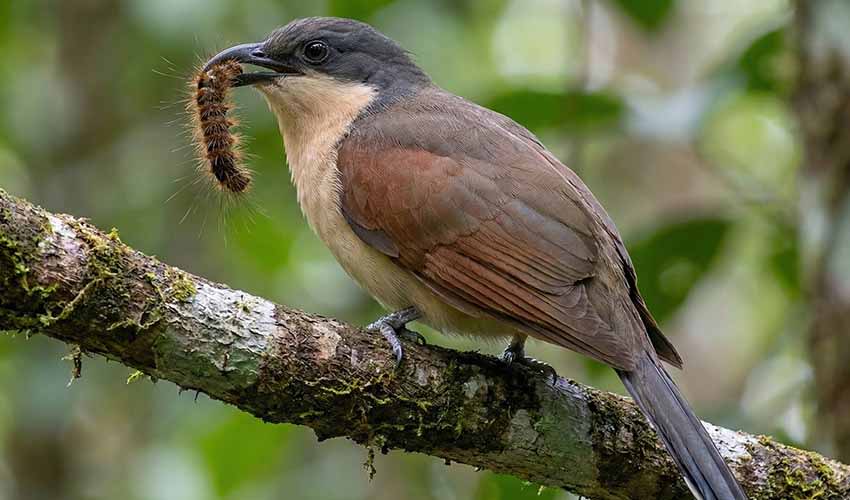
A secretive island bird found nowhere on Earth except Cocos Island, a small, rugged island in the Pacific that belongs to Costa Rica. Because its entire world is basically one rainforest-covered island (about 550 km (342 miles) offshore), it feels like a “hidden local” even among cuckoos. It uses many habitats on the island—bay forests, streamside woods, rainforest, and even cloud forest—ranging from sea level up to about 450 m (1.476 ft).
Looks-wise, it’s built like a classic New World cuckoo: slender, long-tailed, and designed to slip through leaves rather than show off in open sky. Its colors are mostly soft and earthy: a slate-gray forehead and crown, grayish-brown back, and rufous (reddish) wings. The underside is warm-toned—buffy white throat and breast with a richer buff belly—so it can look gently sunlit even in shade. A fun field mark is the bill: the upper part is dark, but the lower part is yellow to yellow-orange with a darker tip, and there’s also a narrow ring of yellowish bare skin around the eye. Flip its tail in flight, and you may catch a bold pattern: the underside is dark with wide white tips.
Behavior is where it becomes extra interesting. The Cocos cuckoo is a year-round resident on the island, but it seems to shift its hangouts: it’s reported more around forest edges in the breeding season and more in the forest interior outside of it. It’s also a bird that’s often heard (if at all) more than seen, and recordings have been scarce; sources note that as of late 2022, there were very few recordings available in major archives. Its song has been described as a rough, throaty series of “eeh” notes, most often given during breeding season and mainly from dawn into late morning.
Distribution
 Costa Rica
 Official estimate
Anything we've missed?
Help us improve this page by suggesting edits. Glory never dies!
Suggest an editGet to know me
Terrestrial / Aquatic
Altricial / Precocial
Polygamous / Monogamous
Dimorphic (size) / Monomorphic
Active: Diurnal / Nocturnal
Social behavior: Solitary / Pack / Herd
Diet: Carnivore / Herbivore / Omnivore / Piscivorous / Insectivore
Migratory: Yes / No
Domesticated: Yes / No
Dangerous: Yes / No




