


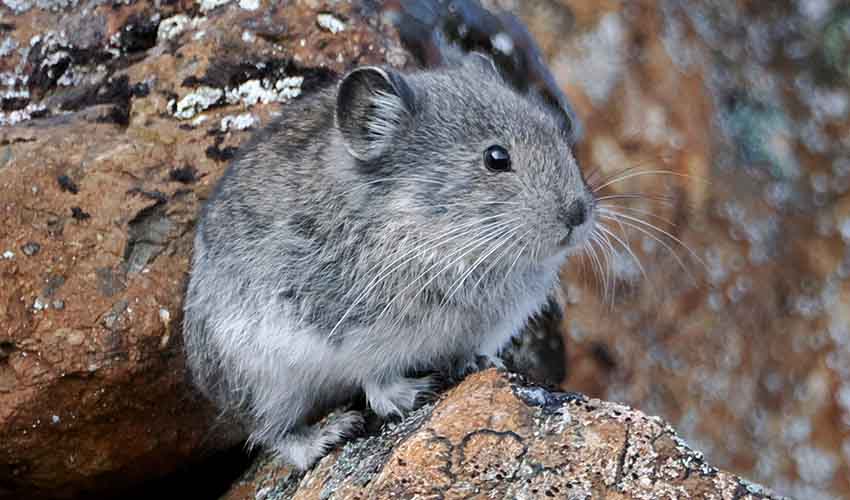
A small, tailless rabbit relative that looks like a tiny, round-eared mountaineer built for cold places. It has a compact body, short legs, and neat, rounded ears rather than the long ears most people associate with rabbits. Its fur is thick and plush, usually grayish-brown with lighter tones on the underside, and it can appear slightly “frosted” in color in rocky, lichen-covered terrain. The name “collared” comes from a paler band of fur around the neck and shoulders that can look like a soft scarf when the animal turns its head. Instead of bounding across open ground, a collared pika scurries and darts, hugging rocks and disappearing into narrow cracks.
This is a pika of high latitudes and high mountains, found in cold regions where winters are long and snow can linger. It’s strongly tied to talus slopes—piles of broken rock—because those rock gaps form a natural fortress of hiding places and temperature shelter. The spaces between stones can stay cooler in summer and offer protection from wind and predators, like an underground maze. Compared with some pikas that dig burrows in soil or live in grassy plateaus, the collared pika is a true rock-home specialist. the
The collared pika is also famous for its “haymaker” lifestyle, which is one of the most fun behaviors in the mammal world. It doesn’t hibernate, so it has to prepare for winter in a different way. During summer, when plants are available, it gathers mouthfuls of grasses, leaves, and flowers and carries them back to a safe spot. Then it spreads the plants out to dry in the sun, like tiny laundry lines of vegetation, before tucking the dried pile into a protected nook for later. These stored “hay piles” can be lifesaving once snow covers the ground and fresh food becomes hard to reach.
Distribution
 Canada
 United States
Anything we've missed?
Help us improve this page by suggesting edits. Glory never dies!
Suggest an editGet to know me
Terrestrial / Aquatic
Altricial / Precocial
Polygamous / Monogamous
Dimorphic (size) / Monomorphic
Active: Diurnal / Nocturnal
Social behavior: Solitary / Pack / Herd
Diet: Carnivore / Herbivore / Omnivore / Piscivorous / Insectivore
Migratory: Yes / No
Domesticated: Yes / No
Dangerous: Yes / No




