


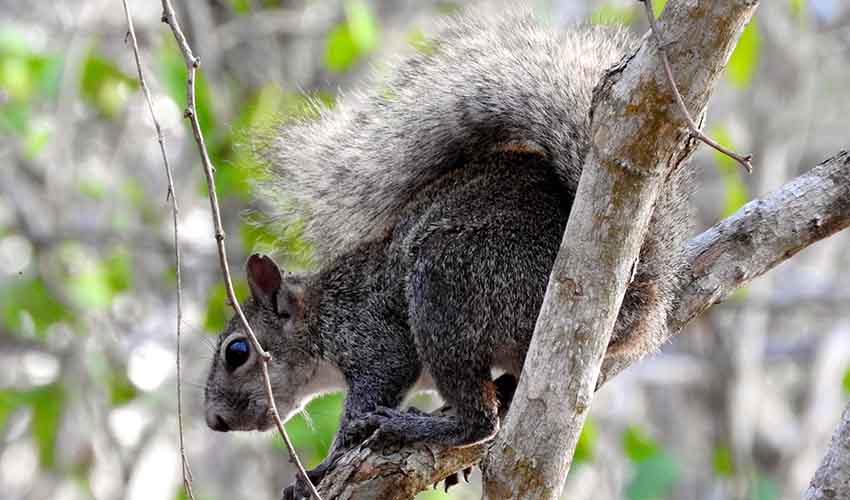
A tree squirrel found only in Mexico, especially along the western side of the country. It lives in places such as Sonora, Sinaloa, Durango, Nayarit, Jalisco, and Colima, where forests, canyons, palms, figs, and other trees provide food and shelter. At first glance, it may look like a gray squirrel, but it has its own special style: a darker gray back, lighter sides, a pale belly that can sometimes look slightly orange, and a striking tail that is dark above with white along the sides. This mix of gray, white, and dark tail coloring helps it blend into branches and forest shade.
One thing that makes Collie’s squirrel different from many familiar squirrels is its close connection to tropical and subtropical forests. It is mainly a tree-dweller and is active during the day, especially around early morning and late afternoon. Instead of spending much of its time in open parks or lawns, it moves through thicker vegetation, forest edges, and subtropical canyons. It has been reported nesting on outer tree branches, inside tree holes, and even in abandoned termite nests, which is a fun and unusual home choice for a squirrel.
Collie’s squirrel mostly eats plant foods, especially fruits and nuts from palms, figs, and possibly oaks. Like other tree squirrels, it may help forests by carrying or dropping seeds while feeding. Its strong claws help it grip bark, while its long tail helps with balance as it climbs and leaps through branches. Compared with smaller dwarf squirrels, it is larger and more noticeable; compared with city squirrels, it is more tied to wild Mexican forests. This makes it a good example of a squirrel shaped by a particular landscape rather than by human neighborhoods.
Distribution
 Mexico
Anything we've missed?
Help us improve this page by suggesting edits. Glory never dies!
Suggest an editGet to know me
Terrestrial / Aquatic
Altricial / Precocial
Polygamous / Monogamous
Dimorphic (size) / Monomorphic
Active: Diurnal / Nocturnal
Social behavior: Solitary / Pack / Herd
Diet: Carnivore / Frugivore / Omnivore / Piscivorous / Insectivore
Migratory: Yes / No
Domesticated: Yes / No
Dangerous: Yes / No




