


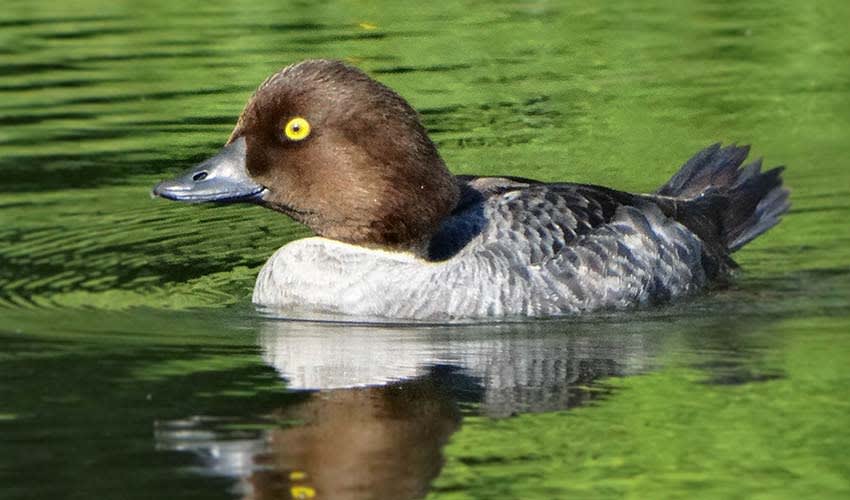
A sharp-looking, sharp-moving diving duck of northern lakes, rivers, and coastal waters — a bird that seems built for both elegance and efficiency. With its glossy green-black head, crisp white cheek patch, and bright golden eyes, the male looks like it’s dressed for a winter gala. Females are more understated in soft brown and gray tones, but they, too, have that distinctive alert expression and bright eyes that make goldeneyes instantly recognizable. Their compact bodies, rounded heads, and sturdy bills give them a purposeful look — no nonsense, all business.
This species is made for cold water, spending summers breeding across the boreal forests of the northern Northern Hemisphere and wintering on lakes, rivers, and coastal bays where ice doesn’t lock them out. Unlike dabbling ducks that feed on the surface, common goldeneyes are true divers. They plunge beneath the water with barely a splash, paddling powerfully with their feet to chase aquatic insects, small fish, crustaceans, mollusks, and plant matter. Their dives are quick and efficient — short underwater bursts, followed by a clean pop back to the surface, eyes bright and alert. When flying, you’ll often hear them before you see them; their wings make a distinctive whistling sound, earning them the nickname “whistlers.”
Spring brings dramatic courtship displays. Males gather on the water and perform snappy, almost comedic head-throwing displays, flipping their heads back until they nearly touch their backs, kicking water, and whistling to impress nearby females. Once paired, the female picks a tree cavity or nest box near a quiet northern lake — goldeneyes are one of the few duck species that regularly nest in trees.
Distribution
 Afghanistan
 Albania
 Algeria
 Austria
 Azerbaijan
 Bahamas
 Bangladesh
 Belarus
 Belgium
 Bermuda
 Bosnia And Herz.
 Bulgaria
 Canada
 China
China Croatia
 Cyprus
 Czechia
 Denmark
 Estonia
 Faroe Islands
 Finland
 France
 Georgia
 Germany
 Gibraltar
 Greece
 Greenland
 Hungary
 Iceland
 India
India Iran
Iran Iraq
Iraq Ireland
 Israel
 Italy
Italy Japan
Japan Jordan
 Kazakhstan
 Korea
Korea Kyrgyzstan
 Latvia
 Lebanon
 Liechtenstein
 Lithuania
 Luxembourg
 Malta
Malta Mexico
 Moldova
 Mongolia
 Montenegro
 Morocco
 Myanmar
 Nepal
Nepal Netherlands
 North Korea
 North Macedonia
 Norway
 Pakistan
 Poland
 Portugal
 Romania
 Russia
 Saint Pierre
 Serbia
 Slovakia
 Slovenia
 Spain
Spain Sweden
 Switzerland
 Syria
Syria Taiwan
 Tajikistan
 Turkmenistan
 Turkey
 Ukraine
 United Kingdom
 United States
 Uzbekistan
Anything we've missed?
Help us improve this page by suggesting edits. Glory never dies!
Suggest an editGet to know me
Terrestrial / Aquatic
Altricial / Precocial
Polygamous / Monogamous
Dimorphic (size) / Monomorphic
Active: Diurnal / Nocturnal
Social behavior: Solitary / Pack / Flock
Diet: Carnivore / Herbivore / Omnivore / Piscivorous / Insectivore
Migratory: Yes / No
Domesticated: Yes / No
Dangerous: Yes / No




