


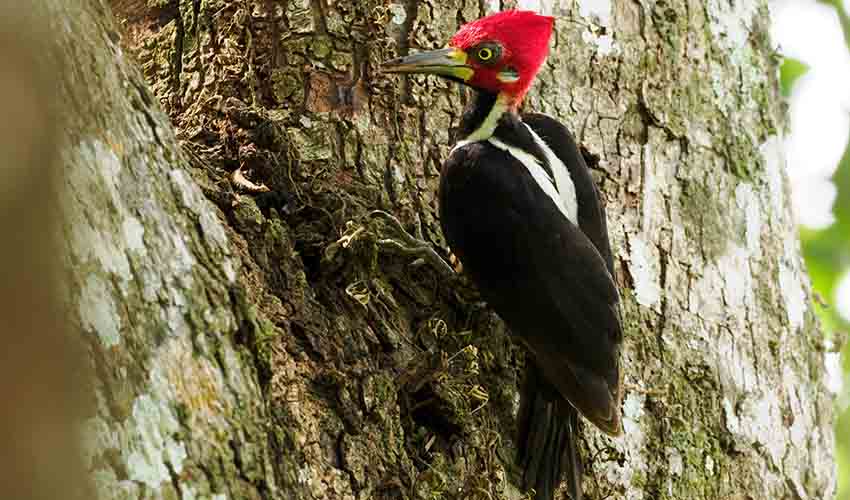
Stretching up to 36 cm (14 inches) long, it’s one of the largest woodpeckers you’ll find in Central and South America. Its most defining feature is, unsurprisingly, its massive, bushy red crest that looks like a permanent, fiery mohawk. Clad in a sleek “tuxedo” of black and white feathers, this bird doesn’t just blend into the bark; it commands the scene. While many woodpeckers are shy, the Crimson-crested has a certain swagger, often seen clinging to massive trunks while hammering away with a bill that looks—and acts—like a professional-grade chisel.
If you’re out birdwatching, you might mistake this bird for its look-alike cousin, the Lineated Woodpecker. However, the Crimson-crested has a few “style choices” that set it apart. First, look at its back: it sports two white stripes that start at the neck and converge at the lower back, forming a perfect “V” shape. In contrast, its cousins usually have stripes that stay parallel. Its face is also a giveaway; the Crimson-crested has a solid red face (in males) or a red face with a large white patch near the bill (in females), whereas similar species often have a white line cutting across the cheek. It’s like the difference between a high-end designer suit and a budget knock-off—once you see the “V” on the back, you know you’re looking at the real deal.
Beyond its looks, the Crimson-crested Woodpecker is a feat of biological engineering. To survive the literal “head-banging” lifestyle, its skull is built with a sponge-like bone structure that acts as a shock absorber, protecting its brain from the force of its own drumming. Speaking of drumming, this bird has a very specific “signature.” Instead of a long, machine-gun rattle, it performs a powerful double-tap—BAM-bam!—that echoes through the forest like a heavy hammer hitting a hollow log. It uses this beat to claim its territory and tell rivals that the tree is officially occupied.
Distribution
 Argentina
 Bolivia
 Brazil
 Colombia
 Ecuador
 French Guiana
 Guyana
 Panama
 Paraguay
 Peru
Peru Suriname
 Trinidad & Tobago
 Venezuela
Anything we've missed?
Help us improve this page by suggesting edits. Glory never dies!
Suggest an editGet to know me
Terrestrial / Aquatic
Altricial / Precocial
Polygamous / Monogamous
Dimorphic (size) / Monomorphic
Active: Diurnal / Nocturnal
Social behavior: Solitary / Pack / Herd
Diet: Carnivore / Herbivore / Omnivore / Piscivorous / Insectivore
Migratory: Yes / No
Domesticated: Yes / No
Dangerous: Yes / No




