


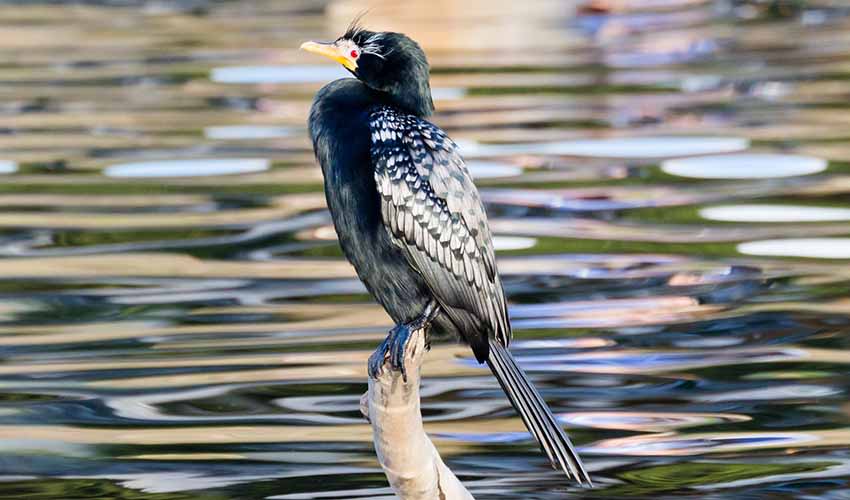
Often seen perched on offshore rocks or flying low over the water, this cormorant is more delicate in appearance than many of its relatives. It has a slim body, long neck, and narrow wings that give it a graceful look both in flight and at rest. Its plumage is mostly dark with a slight greenish sheen, while the head and neck often appear paler, especially during the breeding season. A distinctive crest, or “crown,” of longer feathers on the head gives the species its name and sets it apart from other cormorants.
One of the defining characteristics of the crowned cormorant is its strong association with coastal habitats. It prefers rocky shores, offshore islands, and wave-battered reefs rather than sandy beaches or inland waters. These environments provide ideal conditions for feeding, nesting, and resting. The bird is a skilled diver, plunging beneath the surface to hunt small fish. Using its webbed feet, it propels itself underwater with quick, controlled movements, steering with precision as it pursues prey among rocks and kelp beds. Its slender bill is well-suited for catching small, fast-moving fish.
After feeding, the crowned cormorant often returns to rocks or low cliffs to rest. Like other cormorants, it has non-waterproof feathers, which facilitate diving but require post-dive drying. It is common to see the bird standing with wings spread wide, allowing wind and sunlight to dry its plumage. This familiar posture has made cormorants iconic along many coastlines and has made them a frequent sight in areas where crowned cormorants gather.
Breeding behavior in the crowned cormorant is closely tied to its coastal lifestyle. It nests in small colonies on rocky islands or inaccessible cliff ledges where predators are few. Nests are built from seaweed, grass, and other plant material, forming shallow platforms.
Distribution
 Namibia
 South Africa
Anything we've missed?
Help us improve this page by suggesting edits. Glory never dies!
Suggest an editGet to know me
Terrestrial / Aquatic
Altricial / Precocial
Polygamous / Monogamous
Dimorphic (size) / Monomorphic
Active: Diurnal / Nocturnal
Social behavior: Solitary / Pack / Flock
Diet: Carnivore / Herbivore / Omnivore / Piscivorous / Insectivore
Migratory: Yes / No
Domesticated: Yes / No
Dangerous: Yes / No




