


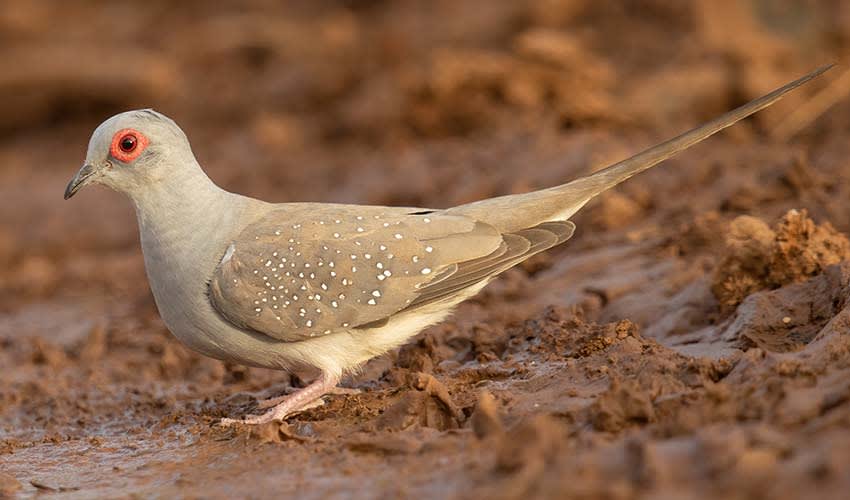
While its body is a soft, smoky blue-gray, it earns its name from the tiny, brilliant white “diamonds” scattered across its wings. These spots look like a handful of stardust has been tossed onto its feathers, shimmering against the darker wing plumage. To finish the look, this dove features a vivid, fiery orange or red ring around its eyes, giving it a bright and inquisitive expression that contrasts beautifully with its muted, earthy tones.
Unlike their larger relatives that need constant access to lush forests, the Diamond Dove is a master of the dry scrublands and grassy plains. They are “ground-dwellers” by heart, spending the heat of the day scurrying across the hot sand with surprising speed to forage for tiny grass seeds. Because they live in such dry environments, they have a remarkable ability to survive on very little water, though when they do find a waterhole, they congregate in large, chatty groups. They move with a light, airy grace, and when they take flight, their wings produce a soft, musical whistling sound that is a signature of the Australian bush.
Beyond their looks, Diamond Doves are famous for their gentle and “romantic” nature. They are highly social and are almost always seen in pairs, often engaging in mutual preening to strengthen their bond. The male has a charming courtship display where he fans out his long tail and bows deeply toward the female, emitting a soft, mournful “coo-coo” that sounds like a tiny flute. Despite their small size, they are incredibly brave parents, building a delicate, platform-like nest made of thin twigs and grass. They are so dedicated to their home that they will often sit perfectly still on the nest even if a person walks right past them, relying on their “diamond-dusted” camouflage to keep them hidden.
Distribution
 Australia
 Puerto Rico
Anything we've missed?
Help us improve this page by suggesting edits. Glory never dies!
Suggest an editGet to know me
Terrestrial / Aquatic
Altricial / Precocial
Polygamous / Monogamous
Dimorphic (size) / Monomorphic
Active: Diurnal / Nocturnal
Social behavior: Solitary / Pack / Herd
Diet: Carnivore / Granivore / Omnivore / Piscivorous / Insectivore
Migratory: Yes / No
Domesticated: Yes / No
Dangerous: Yes / No




