


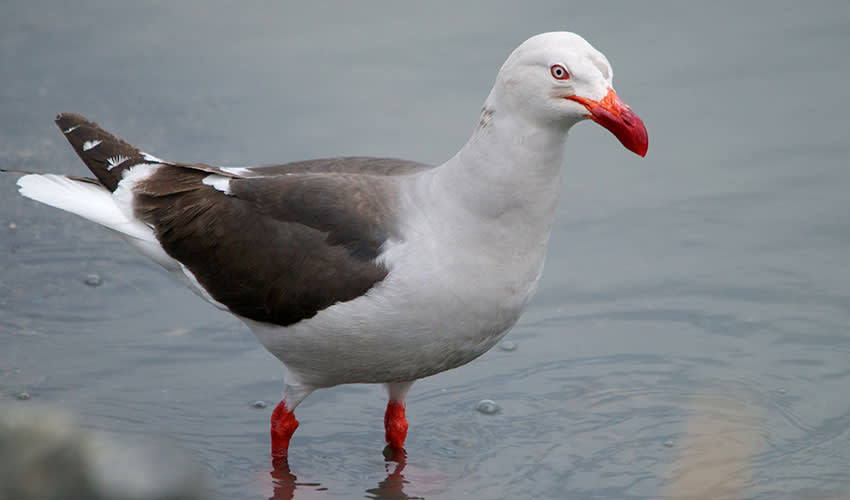
A smart-looking coastal gull of the far southern tip of South America. It lives around the coasts of southern Chile and Argentina and the Falkland Islands, with a few birds wandering to places like South Georgia. You’ll mostly find it on rocky and sandy shores, mudflats, small islands, and especially near noisy seabird and seal colonies where food is plentiful. Up close, the colours are even more striking: the bill is thick and bright red, the legs are red to orange-red, and the eyes are pale with a red eye-ring, giving the bird a very intense stare.
This species is a Patagonian local special. It’s nowhere near as widespread as familiar “seagulls” like kelp gulls; instead, it hugs a limited stretch of the Atlantic and Pacific coasts around Patagonia, Tierra del Fuego, and the Falklands. In these chilly, windy places, it often hangs around mixed colonies of cormorants, penguins, and sea lions. Dolphin gulls are particularly common where humans or animals concentrate food—near fishing harbours, slaughterhouses, and seal rookeries—making use of scraps that would otherwise go to waste. They’re usually seen in small groups or scattered pairs rather than huge flocks, loafing on rocks between feeding forays or marching busily across the tideline.
The diet and feeding tricks of dolphin gulls are one of the coolest things about them. They are opportunistic scavengers and predators, happy to eat everything from mussels and other intertidal invertebrates to bird eggs, chicks, carrion, and offal. Around penguin and cormorant colonies, they specialise in stealing scraps dropped when adults feed their chicks or in raiding unattended nests. Studies in Argentina and the Falklands show that many birds focus heavily on rich “waste” foods such as sea-lion faeces and discarded fish or meat, while others spend more time working mussel beds, dropping shellfish from height to crack them open on rocks. This mix of strategies even leads to individual “specialists,” with some gulls repeatedly returning to the same feeding spots and techniques year after year.
Distribution
 Argentina
 Chile
Chile Falkland Islands
 South Georgia
Anything we've missed?
Help us improve this page by suggesting edits. Glory never dies!
Suggest an editGet to know me
Terrestrial / Aquatic
Altricial / Precocial
Polygamous / Monogamous
Dimorphic (size) / Monomorphic
Active: Diurnal / Nocturnal
Social behavior: Solitary / Pack / Colony
Diet: Carnivore / Herbivore / Omnivore / Piscivorous / Insectivore
Migratory: Yes / No
Domesticated: Yes / No
Dangerous: Yes / No




