


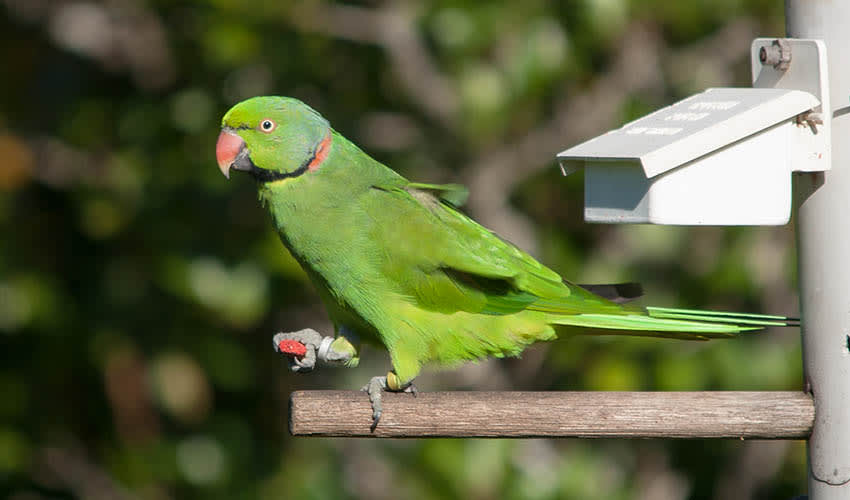
Found only on the island of Mauritius in the Indian Ocean, this medium-sized parakeet is mostly bright green, which helps it blend into the dense native forests where it lives. What sets it apart visually are the darker green to bluish tones on its wings and the subtle black markings on its beak. Its long tail and strong body give it a graceful yet sturdy appearance, suited to life high in forest canopies.
One of the most distinguishing features of the Echo parakeet is its unique voice. Unlike many parrots that produce harsh or screeching calls, this species has clear, ringing calls that echo through the forest, which is how it earned its name. These calls help individuals stay in contact across long distances in thick vegetation. The Echo parakeet is generally social, often seen in pairs or small groups, and it forms strong bonds between mates.
The Echo parakeet stands out from other parakeets due to its strict dependence on native forest habitats. It feeds mainly on leaves, buds, flowers, fruits, and seeds from indigenous trees, making it closely tied to the health of Mauritius’s remaining forests. Unlike more adaptable parakeets that can survive in gardens or farmland, this species relies on specific native plants. It nests in natural tree cavities, which are becoming increasingly rare, further complicating its survival in the wild.
What truly makes the Echo parakeet special is its dramatic recovery from the brink of extinction. At one point, fewer than 20 individuals remained in the wild, making it one of the rarest birds on Earth. Through dedicated conservation efforts, including habitat protection, nest management, and careful monitoring, its population has slowly increased. This recovery has turned the Echo parakeet into a global symbol of successful conservation, showing that even species on the edge can be saved with sustained effort.
Distribution
 Mauritius
 Réunion
 Official estimate
Anything we've missed?
Help us improve this page by suggesting edits. Glory never dies!
Suggest an editGet to know me
Terrestrial / Aquatic
Altricial / Precocial
Polygamous / Monogamous
Dimorphic (size) / Monomorphic
Active: Diurnal / Nocturnal
Social behavior: Solitary / Pack / Herd
Diet: Carnivore / Frugivore / Omnivore / Piscivorous / Insectivore
Migratory: Yes / No
Domesticated: Yes / No
Dangerous: Yes / No




