


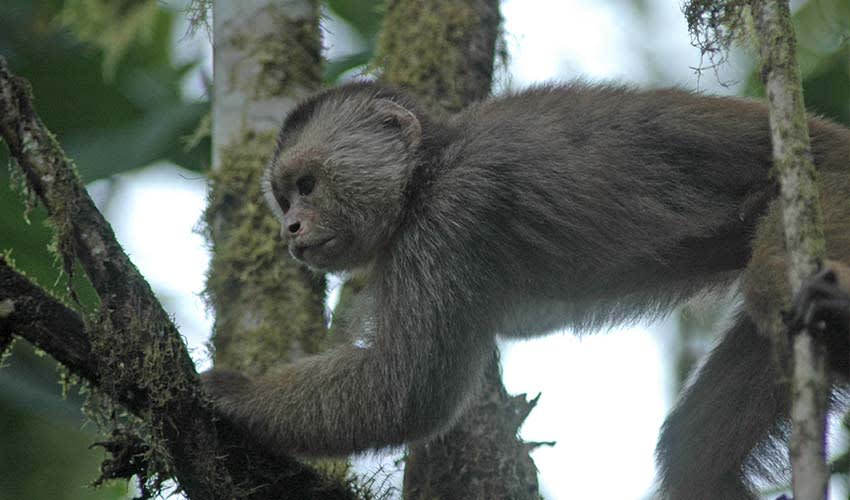
This rare and agile primate lives in the fast-disappearing tropical dry forests and moist lowlands of western Ecuador and northwestern Peru. These monkeys stand out with their soft, light cinnamon or pale brown fur, which fades into a bright, creamy white on their chest, throat, and face. One of their most distinctive features is the dark, brownish “cap” on top of their head, which is usually more subtle and narrow than the deep black markings found on other capuchins. Their long, slender arms and legs help them leap between swaying branches and reach the outer parts of the forest, where the best fruits grow. These spots are too flimsy for heavier primates to reach.
These monkeys are very social and live in groups of up to twenty, usually led by a dominant pair. They are known for “behavioral contagion,” where actions like yawning or scratching quickly spread through the group to keep everyone in sync and alert. Their diet is varied and includes sweet figs, nectar, and protein-rich insects. What really makes them stand out is how they adapt during the tough dry season. When fruit is scarce, they use their problem-solving skills to search the forest floor for snails or get water from the bases of bromeliad plants. They also have “pseudo-opposable” thumbs, which let them peel tiny seeds or pull grubs from tree bark with great precision.
Ecuadorian capuchins are known for some of the quirkiest behaviors among primates. One of their unique habits is “self-anointing.” They catch certain strong-smelling insects or crush specific leaves, then rub the oily residue into their fur to make a natural mosquito repellent. They also have an impressive vocal range, using a mix of trills, whistles, and barks to communicate about threats or food with their group. Another surprising fact is their long lifespan. Even though they are small, these clever monkeys can live for almost forty years, showing just how well they adapt to life in the jungle.
Distribution
 Ecuador
 Peru
PeruAnything we've missed?
Help us improve this page by suggesting edits. Glory never dies!
Suggest an editGet to know me
Terrestrial / Aquatic
Altricial / Precocial
Polygamous / Monogamous
Dimorphic (size) / Monomorphic
Active: Diurnal / Nocturnal
Social behavior: Solitary / Pack / Troop
Diet: Carnivore / Herbivore / Omnivore / Piscivorous / Insectivore
Migratory: Yes / No
Domesticated: Yes / No
Dangerous: Yes / No




