


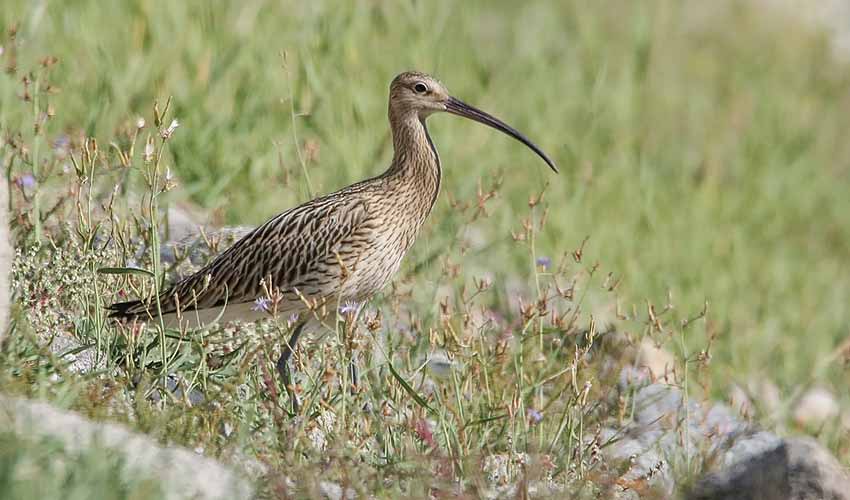
One of the most distinctive shorebirds in the world, instantly recognizable by its long, downward-curved bill—the longest of any wader. This remarkable tool, which can be as long as a human hand, allows the curlew to probe deep into mud and sand for worms, crustaceans, and hidden invertebrates that most birds simply can’t reach. Its soft, brown-mottled feathers offer perfect camouflage in grassy wetlands, blending so seamlessly with the landscape that spotting one feels like discovering a well-kept secret of the marsh.
What sets the Eurasian curlew apart from its close relatives isn’t just its size—though it is the largest of all curlew species—but its combination of power and elegance. While other curlews may share the curved-bill shape, none match the Eurasian curlew’s impressive wingspan, which can stretch nearly a meter wide. This gives it a smooth, gliding flight that looks effortless even in strong coastal winds. Its bill shape is also more specialized than that of other species; females tend to have even longer bills than males, allowing pairs to split food resources by targeting different prey depths.
Beyond its physical traits, the Eurasian curlew is also known for behaviors that make it particularly interesting to observe. During breeding season, males perform dramatic “song flights,” soaring in wide arcs while producing a bubbling, cascading series of notes. This display isn’t just for show—it’s part love song, part territorial declaration, and entirely spectacular to witness. Curlews are also surprisingly loyal to their nesting areas, often returning to the same patch of meadow year after year. While many birds hide their nests, curlews rely on their camouflage and wide-open habitats, trusting distance and visibility more than concealment.
Distribution
 Afghanistan
 Albania
 Algeria
 Andorra
 Angola
 Armenia
 Austria
 Azerbaijan
 Bahamas
 Bahrain
 Bangladesh
 Belarus
 Belgium
 Benin
Benin Bermuda
 Bhutan
 Bosnia And Herz.
 Botswana
 British Indian T.
 Brunei
 Bulgaria
 Burkina Faso
 Burundi
 Cambodia
 Cameroon
 Canada
 Cape Verde
 Central Af. Rep.
 Chad
Chad China
China Comoros
 Congo-Brazzaville
 Croatia
 Cyprus
 Czechia
 Côte D’ivoire
 DR Congo (Kinshasa)
 Denmark
 Djibouti
 Egypt
Egypt Equatorial Guinea
 Eritrea
 Estonia
 Ethiopia
 Faroe Islands
 Finland
 France
 Gabon
Gabon Gambia
 Georgia
 Germany
 Ghana
Ghana Gibraltar
 Greece
 Greenland
 Guam
Guam Guinea-Bissau
 Guinea
 Hong Kong
 Hungary
 Iceland
 India
India Indonesia
 Iran
Iran Iraq
Iraq Ireland
 Israel
 Italy
Italy Japan
Japan Jordan
 Kazakhstan
 Kenya
Kenya Korea
Korea Kuwait
 Kyrgyzstan
 Laos
Laos Latvia
 Lebanon
 Lesotho
 Liberia
 Libya
Libya Liechtenstein
 Lithuania
 Luxembourg
 Madagascar
 Malawi
 Malaysia
 Maldives
 Mali
Mali Malta
Malta Mauritania
 Mauritius
Mayotte
Mauritius
Mayotte Moldova
 Mongolia
 Montenegro
 Morocco
 Mozambique
 Myanmar
 Namibia
 Nepal
Nepal Netherlands
 Niger
Niger Nigeria
 Niue
Niue Nort. Mariana Is.
 North Korea
 North Macedonia
 Norway
 Oman
Oman Pakistan
 Philippines
 Poland
 Portugal
 Qatar
Qatar Romania
 Russia
 Rwanda
Réunion
Rwanda
Réunion Saudi Arabia
 Senegal
 Serbia
 Seychelles
 Sierra Leone
 Singapore
 Slovakia
 Slovenia
 Somalia
 South Africa
 Spain
Spain Sri Lanka
 Sudan
Svalbard
Sudan
Svalbard Sweden
 Switzerland
 Syria
Syria São Tomé & Príncipe
 Taiwan
 Tajikistan
 Tanzania
 Thailand
 Togo
Togo Tunisia
 Turkmenistan
 Turkey
 UAE
UAE Uganda
 Ukraine
 United Kingdom
 United States
 Uzbekistan
 Vietnam
 Yemen
Yemen Zambia
 Zimbabwe
Anything we've missed?
Help us improve this page by suggesting edits. Glory never dies!
Suggest an editGet to know me
Terrestrial / Aquatic
Altricial / Precocial
Polygamous / Monogamous
Dimorphic (size) / Monomorphic
Active: Diurnal / Nocturnal
Social behavior: Solitary / Pack / Herd
Diet: Carnivore / Herbivore / Omnivore / Piscivorous / Insectivore
Migratory: Yes / No
Domesticated: Yes / No
Dangerous: Yes / No




