


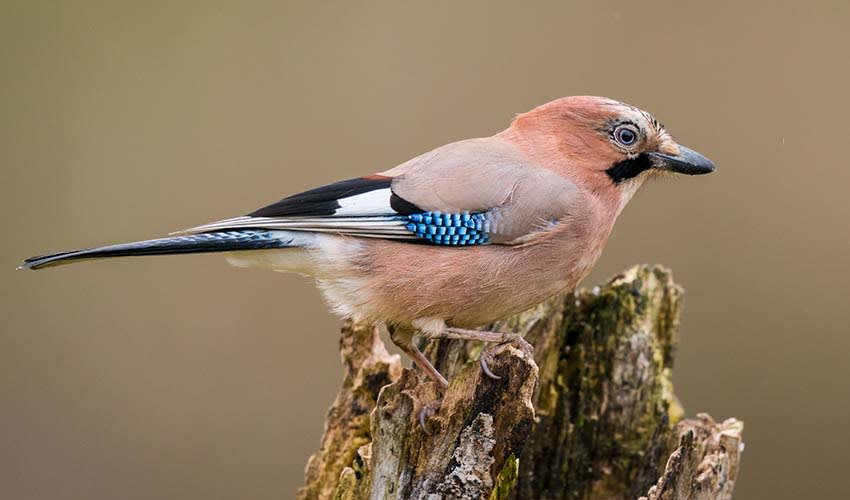
At first glance, it may look soft and gentle because of its pinkish-brown body, but a closer look reveals bright blue-and-black patches on its wings, a bold black “mustache” mark, and a pale crown that can rise slightly when the bird is excited. These colors make it stand out from many other woodland birds, especially because the blue wing feathers can flash brightly when it flies. Like crows and magpies, the Eurasian jay belongs to a very intelligent group of birds, but it is usually more shy and secretive than its louder city-dwelling relatives.
One of the most special things about the Eurasian jay is its love of acorns. In autumn, it collects and buries acorns to eat later. A single jay can store thousands of acorns in one season, using its memory to find many of them again during winter. But the bird does not recover every buried acorn. Some are forgotten and grow into oak trees, helping forests spread and renew themselves. In this way, it is not just a forest resident; it is also a quiet tree planter. This makes it different from many birds that simply eat seeds without helping them travel so far.
The Eurasian jay is also famous for its voice. Its usual call is harsh and loud, almost like a warning scream, and it often alerts other animals to danger. But it can also copy sounds from its surroundings, including other birds’ calls. Some jays can imitate predators, such as hawks, which may help them confuse other animals or protect their food. This talent shows how smart and observant they are. They are careful birds, often watching from cover before flying out into the open. Their mix of caution, memory, and problem-solving makes them one of the most interesting birds in the woodland.
Distribution
 Albania
 Algeria
 Andorra
 Armenia
 Austria
 Azerbaijan
 Belarus
 Belgium
 Bhutan
 Bosnia And Herz.
 Bulgaria
 China
China Croatia
 Cyprus
 Czechia
 Denmark
 Estonia
 Finland
 France
 Georgia
 Germany
 Gibraltar
 Greece
 Hong Kong
 Hungary
 Iran
Iran Iraq
Iraq Ireland
 Israel
 Italy
Italy Japan
Japan Jordan
 Kazakhstan
 Korea
Korea Latvia
 Lebanon
 Liechtenstein
 Lithuania
 Luxembourg
 Malta
Malta Moldova
 Mongolia
 Montenegro
 Morocco
 Netherlands
 North Korea
 North Macedonia
 Norway
 Poland
 Portugal
 Romania
 Russia
 Serbia
 Slovakia
 Slovenia
 Spain
Spain Sweden
 Switzerland
 Syria
Syria Taiwan
 Tunisia
 Turkey
 Ukraine
 United Kingdom
Anything we've missed?
Help us improve this page by suggesting edits. Glory never dies!
Suggest an editGet to know me
Terrestrial / Aquatic
Altricial / Precocial
Polygamous / Monogamous
Dimorphic (size) / Monomorphic
Active: Diurnal / Nocturnal
Social behavior: Solitary / Pack / Flock
Diet: Carnivore / Herbivore / Omnivore / Piscivorous / Insectivore
Migratory: Yes / No
Domesticated: Yes / No
Dangerous: Yes / No




